
In today’s world of e-commerce, Electronic Product Catalogues (EPCs) are an essential tool for businesses to showcase the products they offer and make purchasing easier and increase sales on e-commerce. Due to the increasing number of cyber-attacks as well as the stringent laws governing the protection of information, protecting catalogues and sensitive information is more crucial than ever.
This article helps you with EPC Security and data protection, and best practices, drawing on industry standards to help your company reduce risks, ensure compliance and increase confidence from customers.
No matter if you’re managing your own online shop or B2B procurement process, using these strategies will protect your business and increase its competitive advantage of your business.
What is an Electronic Product Catalog (EPC)?
An Electronic Product Catalog (EPC) is a database that’s digital or an electronic publication that lists the company’s offerings and services and includes details like descriptions, pictures, prices, specifications, and other information. It acts as a storefront online or procurement tool, allowing customers access to shop, research and purchase items online. EPCs are extensively employed in e-commerce, both for customer-facing websites as well as in B2B procurement for supplier-buyer interaction with features that often integrate punch-out capabilities to allow seamless ordering from other systems.
The most important features of EPCs are:
- Customizable access control: Allows for the creation of custom prices and content based on the user’s type (e.g. public and. account holders).
- Simple Management Content: To update information, specifications, and images in real-time.
- Management of attributes: Organising the products in logical order to make it easier to search.
- Payment integration online: Secure transactions through gateways.
- The punch-out features: Allow purchasers to open the catalog through their procurement software and then automate the process of placing orders.
The benefits of EPCs include increased accuracy of orders and efficiency, lower administrative costs, more consistent purchasing and increased customer satisfaction thanks to rapid updates and customised experiences. In the end, EPCs transform traditional catalogs into interactive, dynamic tools that improve efficiency in e-commerce as well as managing supply chains.
Why Security and Data Protection Matter for EPCs
EPCs manage a huge amount of sensitive information, which includes information on products, customer data (e.g. name and email address, addresses as well and purchases), as well as details regarding payments. Security breaches can result in reputational damage, financial loss for the company, and loss of operational and business disruptions, in addition to legal penalties. The most common threats comprise SQL injection as well as cross-site scripting (XSS) as well as malware and phishing, DDoS attacks, and fraudulent transactions with credit cards. This could expose personal identifiable information (PII) and result in identity theft or even fraud using credit cards.
The protection of personal data is crucial in the context of regulations such as GDPR and CCPA that require consent of the individual in the form of transparency, breach notification and disclosure. In the event of an incident that is not handled properly, it can result in fines that could reach as at 4 per cent of global revenue. Security and protection are not only about compliance with the laws, as well as establishing trust that will encourage customers to return to the business and stay loyal in a highly competitive market.
Best Practices for EPC Security
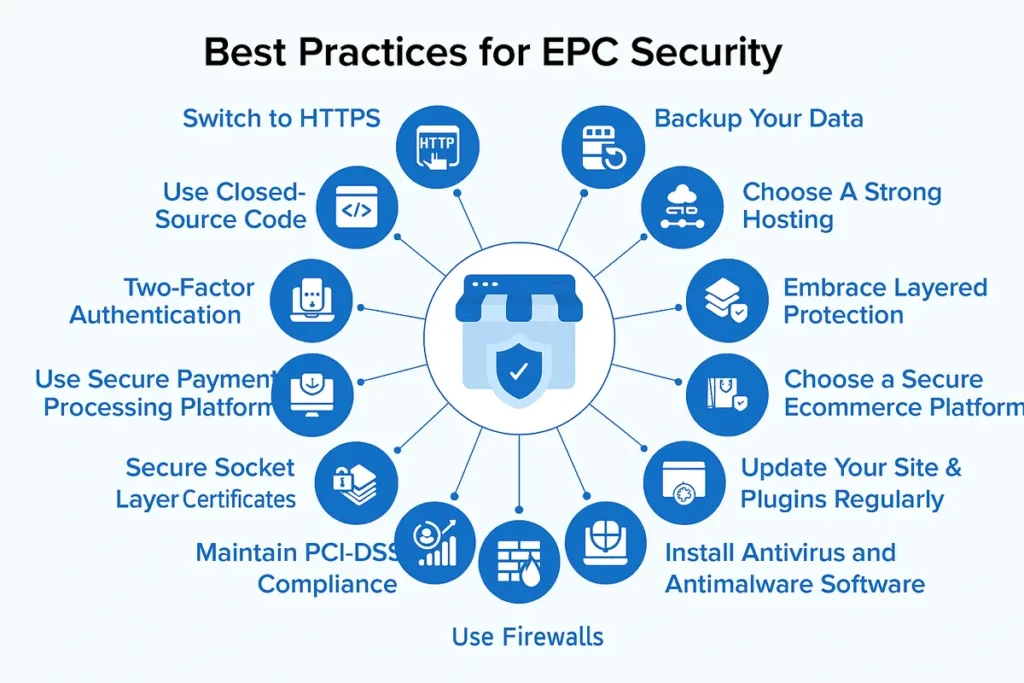
Securing an EPC involves a multi-layered approach to defend against threats. Here are key best practices:
- Implement Multi-Factor authentication (MFA): Require at least two methods of verification (e.g. password, password and app code) for both admin and user access in order to block the entry of unauthorised persons.
- Utilise SSL Certificates and HTTPS: Use encryption to protect data in transit to prevent interception. This is essential for any EPC processing logins or payments.
- Regularly update platforms and plugins: Patch security holes by maintaining the EPC Software (e.g., Shopify, Magento) and add-ons. Automate important updates and test on testing environments.
- Install Web Application Firewalls (WAF): Block malicious web traffic to prevent SQL injections, XSS, and other internet-based threats.
- Conduct Vulnerability Scanning and Testing: Frequently scan for weaknesses and try to simulate attacks to detect and address issues early.
- Train Users and Employees: Training staff on security measures for handling of data. Inform customers about secure ways to limit human error risks.
- Secure Payment Gateways: Integrate reputable gateways that use tokenisation and fraud detection to secure transactions.
- Real-Time Monitoring and Threat Intelligence: Check logs for suspicious patterns and incorporate threat feeds in order to stay ahead of new threats.
With these measures, Businesses can drastically lower the chance of a breach in the security of their EPC systems.
Best Practices for EPC Data Protection
Data protection focuses on protecting data throughout its entire life; for EPCs, that means complying with privacy laws and taking care to minimise the risk.
- Define Data Goals and Automate Classification: Find the most important information (e.g. or PPI, payment information) and then use AI-powered tools to categorise and catalog it in a way that is easier to see.
- Practice Data Minimisation: The goal is to collect only the essential information and then delete it when it is no longer required to limit exposure.
- Encrypt Data at Rest and in Transit: Utilise encryption to safeguard the data stored and transferred from access by unauthorised persons.
- Implement Role-Based Access Controls (RBAC): Limit access to data according to the roles of the user, ensuring that employees only have access to the information they need.
- Ensure GDPR/CCPA Compliance: Request explicit consent through opt-in forms, offer clear privacy policies and permit easy access to data and request deletion. Review practices every six months.
- Centralise Data Loss Prevention (DLP): Utilise a unified DLP system to track and block unauthorised data sharing across channels like email, the web, and other channels.
- Conduct Regular Audits and Training: Review the logs of data handling and train teams on privacy-focused procedures to ensure conformity.
- Manage Cloud Posture with SSPM/DSPM: Search for any misconfigurations on SaaS or IaaS environments to avoid exposures.
- Foster Collaboration and Governance: Set up policies to manage metadata, lineage of data and knowledge sharing to increase the security and quality of data.
- Automate Incident Management: Utilise workflows to react quickly to breaches and notify affected parties within the required timeframes.
These practices aid EPC managers in creating a solid framework for data protection.
EPC System: Implementing Security and Data Protection
For putting these best practices into practice:
- Check Current State: Conduct an audit of security and an inventory of data to find the gaps.
- Select Secure Tools: Choose EPC platforms that come with security functions and integrate the tools to ensure compliance, such as software for managing consent.
- Create Policies: Develop guidelines to control access, retention and response to incidents.
- Train and monitor: Distribute training programs and establish monitoring throughout the day.
- Test and Repeat: Test regularly and refine based upon findings.
Integration with standards like PCI DSS for payment ensures complete security.
Common Challenges and Solutions
- Problem: Keeping up with the Latest Versions
- Solution: Automate patching and utilise managed services.
- Problem: Compliance Across Borders
- Solution: Utilise tools to provide automatic consent as well as breach notification.
- Problem: User Resistance
- Solution: Highlight benefits by training and support for executives.
- Problem Scalability
- Solution: Implement cloud-based solutions utilising central DLP.
Addressing these issues early can prevent expensive issues.
Final Thoughts
Protecting Your Electronic Product Catalog and protecting the information it contains is not only an essential technical requirement but also a strategic imperative. By adhering to the EPC Security and data security best practices, companies are able to not only protect sensitive data about products but also increase trust among partners, distributors, and even customers.
Start with an audit today, and create a system that can help your company achieve its goals in the 2025-year period and even beyond.
FAQs
1. What is the difference between EPC security and data protection?
EPC security is focused on safeguarding the system from security threats such as hacks, and the security of data is about protecting data privacy and conformity with GDPR laws.
2. How can I ensure my EPC complies with GDPR?
Utilise explicit consents to opt-in, limit the collection of data, offer transparent policies, and regularly audit. Consent platforms, such as consent platforms will automate this process.
3. What are the most common threats to EPCs?
SQL injections, XSS, and malware. Phishing attacks, DDoS attacks, and card fraud are all too common, frequently targeting weaknesses in old software.
4. Why is MFA important for EPCs?
MFA is a layer of authentication, significantly cutting down on the risks of accessing unauthorised accounts even when passwords are compromised.
5. How often should I audit my EPC’s security?
At a minimum, every six months or more frequently when handling sensitive data, to detect and respond to new risks.
6. Can small businesses afford EPC security measures?
Yes, many of the cost-effective tools, such as the free SSL certificates, WAFs made open source and cloud-based services, provide the ability to scale up your security.