
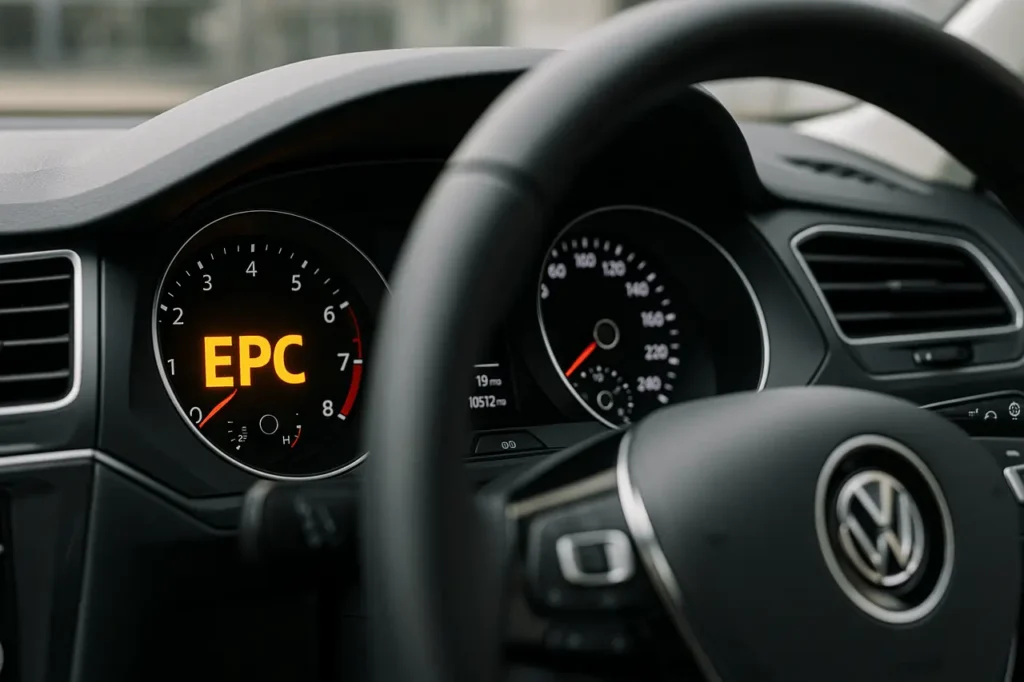
If you’ve ever spotted that “EPC” light on the dashboard of your car, it’s normal to feel anxious. The word “EPC” stands for Electronic Power Control, and it’s a crucial warning light that can be found in a variety of modern cars, including those made by Volkswagen, Audi, Skoda, and SEAT. This light is a sign that the vehicle’s engine management software detects a problem related to the throttle control or cruise control, traction control or the stability control system.
In this comprehensive guide, we’ll explain what EPC mean means in a car. We’ll also explain the reason it is on, how to identify it, the possible fixes, and the best way to avoid it. At the end of this guide, you’ll have a precise knowledge of what EPC is on a car, and the actions to take when it occurs.
Let’s dive.
What Is the EPC Light?
The EPC (Electronic Power Control) light is part of your vehicle’s in-car diagnostics. It’s connected to various essential components of your engine and powertrain, which control the acceleration and stability.
If the EPC light is illuminated, it is a sign of a problem in one or more of:
- System for throttle (electronic throttle body)
- Control system for Traction
- Cruise control system
- The ignition or engine management system
- Light switch for the brake
- Sensor or wire issues in relation to stability or acceleration
In essence, the EPC light indicates that your car’s computer has identified an issue that could affect the performance of your engine or its control system.
Common Causes of the EPC Light
The EPC light may be activated for many causes, from fundamental sensor issues to more intricate electrical problems. The root of the issue usually requires a diagnostic test and a detailed breakdown of the most common causes:
Overview of common causes, descriptions, and affected components in EPC systems.
| Cause | Description | Affected Components |
|---|---|---|
| Throttle Body Malfunction | Dirt buildup or electronic failure in the throttle valve prevents proper air-fuel mixture control. | Throttle body, accelerator pedal sensor |
| Faulty Sensors | Issues with the engine speed, camshaft, or crankshaft position sensors disrupt signal to the ECU. | Crankshaft/camshaft sensors, mass airflow (MAF) sensor |
| Low or Dead Battery | Voltage drops can confuse the EPC system, mimicking sensor failures. | Battery, alternator |
| Brake Light Switch Problems | A worn switch affects cruise control and throttle integration. | Brake light switch |
| Traction/Stability Control Issues | Faults in ABS or ESP systems interfere with power distribution. | ABS module, wheel speed sensors |
| Air Intake or Vacuum Leaks | Loose hoses or faulty O-rings cause improper air flow. | Intake manifold, vacuum lines |
| Fuel System Glitches | Problems with injectors or metering lead to misfires. | Fuel injectors, pump |
| Wiring or ECU Faults | Corroded connections or software glitches in the engine computer. | Wiring harness, ECU |
This is more apparent when driving vehicles that have higher mileage (over fifty thousand miles) or those that are exposed to severe cold, road salt or.
Symptoms When the EPC Light Comes On
The EPC light isn’t always visible as a whole, but it’s usually coupled with obvious drivability issues. Be aware of the following red flags:
- Reduced acceleration: The car you drive feels unresponsive, without any response beyond 40 miles per hour or 4000 RPM.
- Engine shaking or misfiring: Idling that is rough or hesitation when shifting gears or stalling.
- Limp Mode activation: The vehicle is able to limit speed at 30-40 mph, and could lock into a low gear to protect the engine.
- The loss of cruise Control: Inability to maintain the set speed.
- The Check Engine Light Companion: Sometimes, it is paired with the general warning about engine problems for more complicated issues.
- Informationtainment blackouts: In certain Volkswagens, the digital display might blink or stop working.
In the worst instances, the engine could completely shut down, leaving you. When the flashing light appears quickly, it could be a sign of an active misfire. Pull over immediately.
How to Diagnose the EPC Light
The process of diagnosing an EPC problem involves checking the onboard computer of the vehicle with the OBD-II scan. Here’s the process step-by-step:
- Utilise an OBD-II scanner: Connect the scanner to the diagnostic port on the dashboard.
- Get Error Codes: This scanner can show codes like P2122, P2138 or P2101 that indicate sensors or throttle issues.
- Read the code: Each code provides an insight into the area that is part of the EPC system that is failing.
- Check electrical connections: Inspect wiring harnesses and connectors for signs of corrosion as well as loose connectors.
- Examine the Throttle System: Check the throttle body and the accelerator pedal for damage, dirt or wear.
If you aren’t connected to an OBD-II scanner, an auto mechanic or dealer can do this diagnosis for you.
How to Fix the EPC Light
The precise repair is contingent upon what caused the EPC light. Below are a few of the popular options:
1. Clean or Replace the Throttle Body
A buildup of carbon within the throttle body can lead to an airflow issue and cause an EPC warning. Cleaning it using a cleaner for the throttle body will often fix the problem.
2. Replace Faulty Sensors
If a sensor, such as one of the MAF, MAP or the throttle sensors for position, is damaged, you can replace the sensor, which usually eliminates the EPC light.
3. Repair Brake Light Switch
A broken brake light is a quick and cheap fix that could remove EPC warnings. EPC warning.
4. Fix Wiring or Electrical Issues
Removing damaged or repaired connectors, wires, or fuses can help bring back the proper transmission of signals.
5. Update ECU Software
In some cases, a software upgrade or ECU Reprogramming by an authorised dealer could solve ongoing EPC problems.
6. Replace Ignition Components
If ignition coil malfunctions are the cause of EPC issues, changing spark coils and plugs could resolve the issue.
Are you able to drive using an EPC Lamp On?
The short answer is: it depends. It’s a matter of preference. May drive short distances when EPC lights are on. EPC lights are on; however, it’s not advised. This EPC device is connected to the car’s stabilisation and engine control features, which means that the problem could get worse quickly.
If your vehicle goes into limp mode, it’s designed to reduce performance to avoid further damage. It is recommended to:
- Beware of high-speed collisions
- Beware of accelerations that are too strong
- Be careful when driving to the closest repair shop or mechanic
Inattention to the EPC signal could lead to lower engine performance and a higher consumption of fuel, or risk to safety..
How to Avoid Tips to EPC refer to a car.
Make sure you keep your EPC system running smoothly by performing routine maintenance:
- Regular tune-ups: Change Air filters once every 15,000 miles. Also, change spark plugs according to the manufacturer’s schedule.
- Battery Tests: Check each year. Replace every 3 to 5 years.
- Software Updates: Visit dealers for ECU flashes during oil changes.
- Soft Driving: Avoid excessive acceleration in cold weather, as it puts the throttle under strain.
- Professional Inspections: Every year, diagnostics are used to identify problems early, thereby saving hundreds of dollars.
Proactive care can extend the life of your VW or Audi’s warranty and ensure that warranty coverage remains intact.
Final Thoughts
An LED for the EPC on the dashboard of your car isn’t something to be ignored. It’s a sign that your vehicle’s electronic controller has identified a problem that is usually related to the throttle, traction, or ignition mechanisms.
Understanding the meaning of EPC is essential for an automobile, and being aware of the signs and taking prompt remedial and diagnostic actions will help you avoid severe engine problems and ensure the safety and performance of your vehicle. Always seek out professional assistance in case you aren’t sure of the root of the issue or how to fix it.
FAQs About the EPC Light
1. What exactly does EPC refer to on the dashboard of a car?
EPC is an acronym for Electronic Power Control, a system for controlling engine power and throttle on Volkswagen Group vehicles.
2. Does the EPC light resemble Check Engine lights?
It’s not exactly, but it’s more akin to powertrain and throttle faults. However, it’s often seen along with the check engine warning light.
3. Do low levels of oil trigger the EPC light to turn on?
Yes, low oil levels can cause it to occur by affecting the sensor in the engine, and could lead to severe damage if not addressed.
4. What is the cost to repair an EPC problem that is not a major one?
Costs can vary from $50 to $200 for sensor repairs or DIY fixes, $300 to $1,000 for professional repairs to ECUs or throttles.
5. Does the EPC light reset itself?
Sometimes, following an electrical disconnect or a short drive, however, persistent problems require diagnosis and repairs.
6. Does the EPC light impact the warranty of my car?
However, addressing the issue quickly will not void the coverage of similar components.
7. How can I repair my EPC bulb at home?
Basic checks are acceptable; however, more complicated issues, such as sensor calibration, require a professional mechanic or dealer.
8. What is the reason why the EPC light flickers infrequently?
It could be caused by a loose connection or a sensor failure under load (e.g. when you accelerate).