
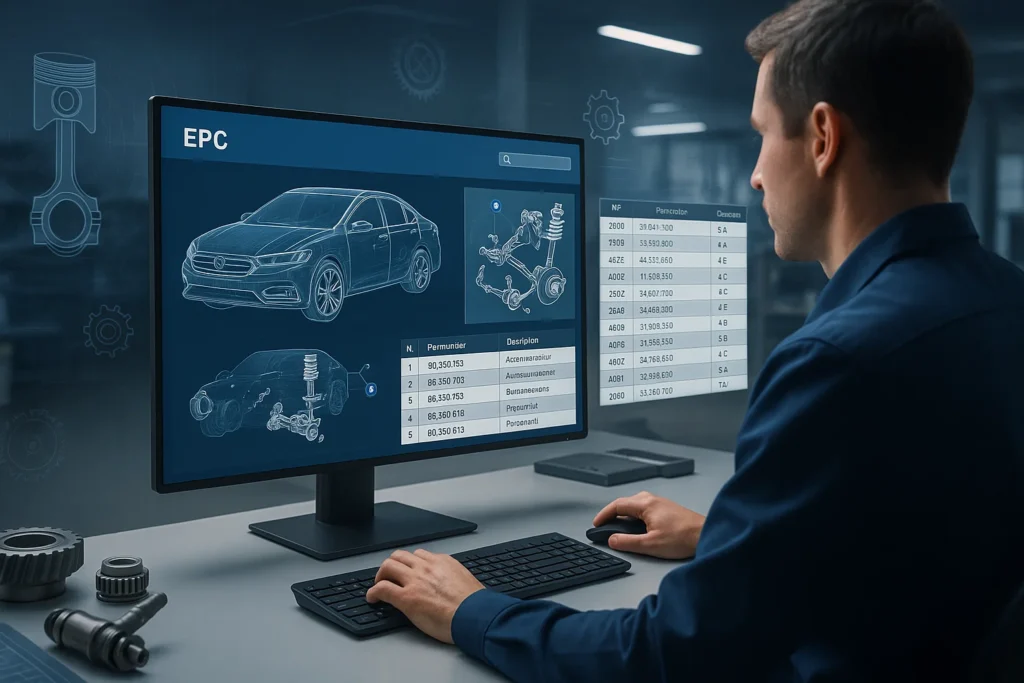
In the ever-changing world of the automobile and machinery industries, ensuring that parts are managed efficiently is vital. If you’re a mechanic, dealer or parts distributor and need to find the right parts quickly, it could make or break your business. This is the reason Electronic Parts Catalogues (EPCs) come in.
An Electronic Parts Catalogue is a computerised system that serves as a central database of components and parts used in vehicles, machines or equipment. It aids users in identifying how to locate, order, and purchase the correct part with precision and accuracy, avoiding manual search errors and allowing for a better use of time.
In this article, we’ll go over the essential information you need about EPC, including how they function as well as their primary advantages, the most critical functions, and how they’ve become indispensable tools in modern-day parts management.
What is an Electronic Parts Catalog (EPC)?
The Electronic Parts Catalogue (EPC) is an electronic platform that stores and displays information about parts for machines, vehicles, or other equipment in an interactive and searchable format. It replaces paper catalogues and allows users to get access to the most current data on parts prices, diagrams, and other information using a computer or online interface.
EPCs are utilised by dealerships, manufacturers and repair facilities to:
- Find the right parts that are required for a specific model.
- See detailed diagrams of the components.
- Check the availability of stock and pricing.
- Generate accurate parts quotes or orders.
For instance, an auto dealer could use an EPC to input the VIN and instantly get a complete list of all the parts available for the model. This helps avoid ordering mistakes and also ensures compatibility.
How an EPC work?
An EPC operates as a computer-driven software system connected to manufacturers’ databases. This is how it usually functions:
- Data integration: Manufacturers upload structured information, such as part numbers, descriptions, pictures, pricing and compatibility information into the catalogue.
- Model Lookup or VIN: Users can search by using a VIN, model code, chassis number or part number.
- Interactive Diagrams: The EPC displays an exploded diagram showing how the parts connect.
- Selection and ordering: Users can select items, view the status of stock, and create an estimate or directly order through the catalogue.
- Real-time updates: Cloud-driven EPCs automatically connect to manufacturer databases to ensure that the most current information is always accessible.
The most modern EPC systems are typically linked with the management of inventory, procurement, and Dealer Management Systems (DMS) for seamless workflow automation.
Key Features of an Electronic Parts Catalog
A well-designed EPC is packed with features that make it essential for dealers, manufacturers and repair shops too. Here are the top features:
1. Advanced Search Options
Users can search for parts using the part number, keywords, model, VIN or by category. This will ensure quick and accurate identification.
2. Diagrams with Exploded
EPCs offer high-resolution exploded-view diagrams that visually show the ways that components fit into assemblies. This helps identify the proper component simply, even for people who aren’t experts.
3. VIN Lookup Function
This feature lets customers input the VIN number of their vehicle and get all the parts that are compatible. This reduces the chance of purchasing the wrong part.
4. Live-Time Updates of Data
Manufacturers can make live updates on prices, availability of parts, as well as technical specs, which ensures that customers have access to the latest information.
5. Cross-Reference tools
These tools can match OEM (Original Equipment Manufacturer) parts to other aftermarket parts or alternatives that are compatible to help businesses discover affordable options.
6. Integration with Other Systems
Modern EPCs work effortlessly with DMS, ERP and CRM systems for more efficient processes and better customer support.
7. Multi-Language Multicurrency and Multicurrency Assistance
To support global activities, EPCs support multiple languages and currencies, easing the management of international parts.
8. mobile and cloud accessibility
Cloud-based EPCs can be accessed from any location and on any device, making it more straightforward for field technicians as well as mobility-based service companies.
Benefits of Using an Electronic Parts Catalog
The benefits of the use of EPCs are numerous. This is how they provide value to various parties:
1. For Manufacturers
- Data distribution is simplified for suppliers and dealers.
- Reduces printing and distribution expenses of catalogues printed on paper.
- It ensures consistency of brand and product information across markets around the world.
2. for Dealers as well as Distributors
- The system speeds up the generation of quotes and parts ordering.
- Reduces inventory errors by ensuring part identification.
- Increases customer satisfaction by providing speedier service.
3. To Mechanics and Repair Shops
- Instant access to technical drawings and assembly guides.
- It ensures that parts are compatible for the specific machine or vehicle.
- Reduces downtime by locating parts quickly.
4. For Customers
- Increases transparency when selecting parts and pricing.
- Reduces errors in delivered parts.
- Increases the speed of service turnaround.
In the simplest terms, an EPC improves efficiency as well as accuracy across the entire chain.
Types of Electronic Parts Catalogs (EPC)
EPCs are classified by their structure and the method of deployment. Each type is tailored to meet specific requirements for businesses based on variables such as accessibility, scalability and data management.
1. OEM EPCs
Created and maintained through OEMs. They support and update the catalogues. (OEMs), These catalogues are backed by genuine and verified data, which ensures 100% part compatibility. They are frequently integrated with dealer networks and utilised for authorised repair centres to provide warranties and authentic parts management.
2. Aftermarket EPCs
The catalogues include information for replacement or third-party parts and are extensively used by repair shops that are independent and parts distributors. They typically include cross-references with OEM part numbers, which helps customers to find affordable alternatives that do not compromise on quality.
3. Cloud-Based EPCs
Online and accessible through mobile or desktop browsers, Cloud-based EPCs come with instant updates and simple scaling. They are ideal for companies with multiple branches as well as technicians on the move who require access to accurate information about parts at any time.
4. On-Premises EPCs
Local servers are used to host the EPCs. These EPCs provide greater control over data as well as security, which makes them ideal for companies that have strict IT guidelines. However, they need periodic updates and manual maintenance, which can add to the operational cost when compared with cloud-based solutions.
How EPCs Are Changing the Parts Industry
Prior to EPCs being introduced, the management of parts depended heavily on manuals printed on paper as well as manual cross-referencing – a time-consuming and error-prone procedure. In the present, EPCs have transformed how companies manage and purchase parts, introducing the use of digital precision and automation.
With features such as the AI-driven search, predictive maintenance insights, and real-time availability monitoring, Modern EPCs aren’t just catalogues; they are powerful tools that drive digital transformation across all industries.
How to Choose the Right EPC
The right electronic Parts Catalogue (EPC) is an important decision that could significantly affect your efficiency in operations in terms of customer satisfaction, as well as the overall performance of your business. When you are evaluating EPC options, think about the following key aspects to help you make an informed decision:
1. Quality of Data and Frequency of Update
An effective EPC will be able to provide regular and up-to-date information directly from the manufacturer or trusted sources. This will ensure that part numbers, as well as prices and compatibility information, are always up-to-date to avoid costly errors and returns.
2. Navigation and Ease of Use
An easy-to-use interface that includes an intuitive search and filters aids teams in finding the components they require. Select an EPC that has visual diagrams as well as VIN lookups and precise categorisation to cut down on the amount of training time and increase productivity.
3. Integration Compatibility (ERP, CRM, DMS)
Make sure that you can ensure that EPC is seamlessly integrated with your current systems, such as enterprise Resource Planning (ERP), Customer Relationship Management (CRM), and Dealer Management Systems (DMS). The seamless integration of your systems streamlines data flow, automates processes, and reduces the need for duplicate work.
4. Support for multiple brands or Models
If your company deals with multiple brands, go for an EPC that supports cross-platform and multi-brand compatibility. This lets us manage a wide products on a unifying platform.
5. Cost and Model for Licensing
Examine the features of EPC’s cost structure, license conditions and scaleability. Specific systems offer subscription-based plans. Others need a one-time licensing fee. Think about your long-term requirements for the price of updates and access to additional users.
6. Cloud vs. On-Premises Deployment
Choose between cloud-based or on-premises deployment based on the requirements of your business. Cloud-based EPCs provide the flexibility of automatic upgrades and remote access, while on-premises systems offer more control over data and offline access.
7. Customer Reputation and Vendor Reputation
Be sure to check out the company’s performance as well as their reliability and satisfaction. Find EPC suppliers with a solid knowledge of the industry, prompt technical support, as well as extensive training materials to ensure long-term achievement.
Final Thoughts
An Electronic Parts Catalogue (EPC) is much more than an electronic listing. It’s a complete solution for efficient management of parts. Through streamlining the identification of inventory, ordering, and identification procedures, EPCs help businesses cut costs, increase accuracy, and provide better customer service.
It doesn’t matter if you’re a manufacturer looking to make your data more accessible, as well as a shop for repairs that is looking to speed up turnaround times; using an EPC is an excellent step towards modernisation and efficiency.
Frequently Asked Questions (FAQs)
1. What is the primary reason for an EPC?
The primary goal for the EPC is to make it easier for the procedure of identifying, finding and ordering components efficiently through a single digital platform.
2. Who can benefit from Electronic Parts Catalogues?
EPCs are employed by dealers, manufacturers, repair shops, distributors and service centres in the industrial, automotive and machinery industries.
3. Can EPCs be tailored to particular brands or industries?
Yes. A lot of EPC companies offer industry-specific or brand-specific versions adapted to particular workflows and formats for data.
4. Are EPCs only available for parts for automobiles?
No. Although they are used extensively in the automobile sector, EPCs are also used in the construction equipment, agricultural machinery, aviation and marine industries.
5. What can EPCs do to increase the accuracy of EPCs?
EPCs provide real-time, manufacturer-verified data and VIN-based search options to ensure correct part selection, reducing costly errors.
6. What is the difference between EPCs from OEM and aftermarket?
OEM EPCs are based on the original data of the manufacturer, whereas EPCs for aftermarket use provide information on the replacement or compatible parts that are available from third-party suppliers.
7. Do EPCs have to be connected via the internet?
Cloud-based EPCs require internet connectivity; however, on-premises versions are able to operate offline and have regular data sync.
8. What is the cost of one EPC System?
Costs differ based on the features, the number of users, and the type of deployment. Smaller businesses can make use of low-cost cloud services, whereas big companies typically opt for enterprise-grade EPCs.