
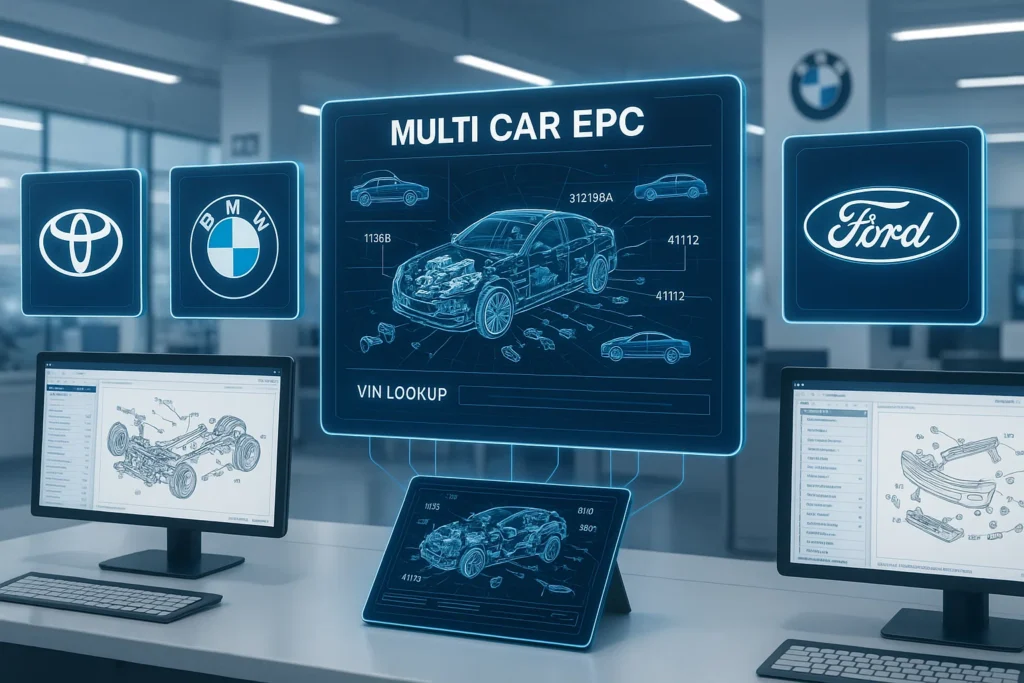
In the auto industry, managing spare part information effectively across various brands has been a problem. As dealerships grow and businesses manage several vehicle lines and brands, keeping separate electronic catalogs of parts (EPCs) for every brand becomes tedious expensive, time-consuming, and costly.
Join the Multi Brand EPC (Electronic Parts Catalog). This one-stop solution allows automotive dealers, distributors and workshops to manage and search for spare parts from a variety of vehicle brands through one platform.
This article will explain the way a multi brand EPC functions with its advantages, the benefits, and aspects of implementation and ways it could change the way you manage your parts.
What is a Multi Brand EPC?
A Multi-Brand Electronic Parts Catalog is a more advanced version of an electronic parts catalogue that is designed to integrate parts data from a variety of car brands into a single interface.
Instead of having to switch between different EPCs for brands like Toyota, Ford, BMW, Volkswagen, Users can get access to all the information needed for parts such as diagrams, part numbers, compatibility details and pricing from a single dashboard.
This integration aids in streamlining the processes to:
- Multi-brand dealerships for automobiles
- Independent workshops
- Parts distributors and dealers
- Companies that maintain fleets
In essence, it’s a complete instrument to manage complex inventories of brand-new parts efficiently.
Essential: The advantages of a Multi Brand EPC
A high-end Multi Brand EPC is equipped with the latest functions to manage massive amounts of data and guarantee smooth operation. These are the most important attributes:
1. Unified Search and Lookup
Searchers can locate components through the VIN (Vehicle Identification Number), model, part number or keywords regardless of the manufacturer. The EPC efficiently retrieves relevant information across different brands, which saves a significant amount of time as well as effort.
2. The Visual Diagram and the Exploded View
Interactive diagrams help to find the correct parts visually. This helps reduce errors in parts order and increases the accuracy of the repair process and maintenance.
3. Cross-Brand Compatibility
Multi-Brand EPCs are able to identify parts that can be interchanged between brands, aiding workshops in finding low-cost alternatives and reducing downtime when certain parts aren’t available.
4. Updates and synchronisation of data
Regular updates ensure that information about parts remains accurate, incorporating the most recent releases from manufacturers, as well as price changes and even discontinued products.
5. Integration with ERP, CRM, and DMS
Modern EPCs can easily be integrated with enterprise software systems such as ERP (Enterprise Resource Planning), CRM (Customer Relationship Management), and DMS (Dealer Management Systems), allowing seamless inventory management, order processing, and customer support.
6. Cloud-Based Access
Cloud-based EPCs permit authorised users to browse the catalogue on any device, providing the flexibility needed by remote teams or several dealerships.
7. Multi-Language and Multi-Currency Support
For businesses that are global, this feature provides access to all regions, which increases the accessibility of diverse teams and customers.
Advantages of Using an EPC with a multi brand EPC
Implementing a Multi-Brand EPC provides significant advantages to auto companies with multiple brands.
1. Streamlined Operation
Instead of having to switch between various EPC systems, employees can complete all searches, comparisons, and order procedures from one interface. This simplifies and accelerates the process.
2. Cost Efficiency
Maintaining an individual EPC system is considerably less expensive than licensing and maintaining several brand-specific EPCs. It also lowers costs for training and IT support.
3. Increased Accuracy
Centralised data helps reduce human error when it comes to part selection and pricing, increasing the accuracy of orders and customer satisfaction.
4. Faster Turnaround Time
Through quick searches and other images, engineers as well as parts managers can find the required components quickly, thereby reducing the speed and turnaround time.
5. Better Inventory Management
By connecting EPC data to DMS or ERP software, the levels of inventory will be automatically updated as parts are purchased or sold, which will allow for better control of inventory.
6. Scalability
If your workshop or dealership grows to accommodate new brand names, you are able to easily integrate their information into the current EPC without reorganising the entire system.
7. Enhanced Customer Experience
More precise and faster parts identification ensures that customers are able to repair their equipment quickly, which results in higher satisfaction and more repeat business.
The Challenges of implementing the multi Brand EPC
Although the benefits are substantial, businesses should also take into account the following issues before implementing multi-brand EPC:
- Complexity of Data: Integrating parts data from different brands requires the use of a standardisation process and validation.
- License Restrictions: Some OEMs may be restricted in access to data or licensing fees.
- Compatible with System: Making sure that the system is compatible with ERP systems or DMS systems may require customised integrations.
- Education Requirements: The employees must be taught to navigate and use the brand-new EPC system effectively.
But with the right supplier and plan, these issues can be effectively managed.
How to Select the Best Multiple-Brand EPC
When choosing a multi-brand EPC for your company, be sure to consider these factors:
- Brand coverage: It must support all brands of vehicles that you deal with.
- Regular Updates: Updates on a regular basis are vital to ensure data accuracy.
- Integration Capability: This should allow you to connect to your CRM, ERP, or DMS easily.
- UX: Choose an EPC that has an intuitive and simple-to-use interface.
- Renowned Vendor: Review customer feedback, as well as reliability, along with technical assistance quality.
- Modification Options for Customising: The EPC should permit brand-specific settings, filters and workflows.
- Safety as well as Compliance: Ensure the system complies with the data Security standards as well as OEM guidance.
Best Practices to Use an EPC with a Multi-Brand EPC
To maximise the value from your EPC:
- Make sure your team is regularly trained to keep them up-to-date with changes to the system.
- Integrate EPC data into inventory systems for automated update of stock.
- Make use of VIN lookups to ensure accuracy.
- Regularly audit your business to ensure consistency of data across all brands.
- Make use of analytics tools to analyse the trends in purchasing and parts.
The Future of Multi-Brand EPCs
The future of multi-brand EPCs is the automation of AI, along with the use of predictive analytics. Advanced EPCs are now using AI to:
- Predict demand for parts based on information about the use of vehicles.
- Automatically suggest compatible alternatives.
- Enable voice search for quick lookups.
- Integration with AR (Augmented Reality) for visual identification of parts in real-time.
As the automotive industry becomes more interconnected, multi-brand EPCs will play a larger role in the digital transformation.
Final Thoguhts
A Multi Brand Electronic Parts Catalog is not just an added convenience. It’s an essential requirement for any modern auto business managing several brands. It makes complex tasks more manageable, improves efficiency, and increases overall accuracy in the management of parts.
When you invest in a solid, fully integrated EPC system, you will not just save time and money but also increase customer confidence and service quality, which is an essential step to remain on top of the fast-changing automobile market.
FAQs Multiple Brands EPC
1. What is a Multi Brand EPC?
A Multi-Brand EPC is an electronic parts catalogue that enables users to search and manage information about parts for various vehicle brands through the same system.
2. What makes an Multi Brand EPC different from an ordinary EPC?
A standard EPC is compatible with only one brand, whereas the multi-brand EPC incorporates data from multiple brands, allowing for greater capabilities and greater the convenience.
3. Who could benefit from a Multi Brand EPC?
Workshops, multi-brand dealerships fleet operators, dealerships, and parts distributors gain the most from the unified EPC systems.
4. Does a Multi Brand EPC require special authorisation?
Yes, certain OEMs might need licensing agreements or access to data permissions, dependent on the platform and the brands involved.
5. Do I have the ability to integrate the Multi Brand EPC with my existing ERP or DMS?
The most modern EPCs have API integration, which makes it simple to integrate with existing systems to provide smooth data flows.
6. How often is an Multi Brand EPC updated?
It differs by vendor; however, the top EPCs update their information weekly or every month to ensure accuracy.
7. What is an Multi Brand EPC cloud-based?
A lot of modern EPCs are cloud-based, providing the flexibility of remote accessibility as well as automatic upgrades.
8. What are the most significant advantages of using the Multi-Brand EPC?
Cost savings, unification of access, higher accuracy, speedier search, scaling, and better customer service.
Hi is this catalogue available in malaysia.? what are car brands do you have. Thanks
Hi! Thanks for your question. This article talks about how a multi-brand EPC lets you use one catalogue for many different car brands.
Whether it’s available in Malaysia and which brands are included depends on the EPC provider you go with.
If you want, I can help you check the available options for Malaysia and the supported car brands — just let me know!