
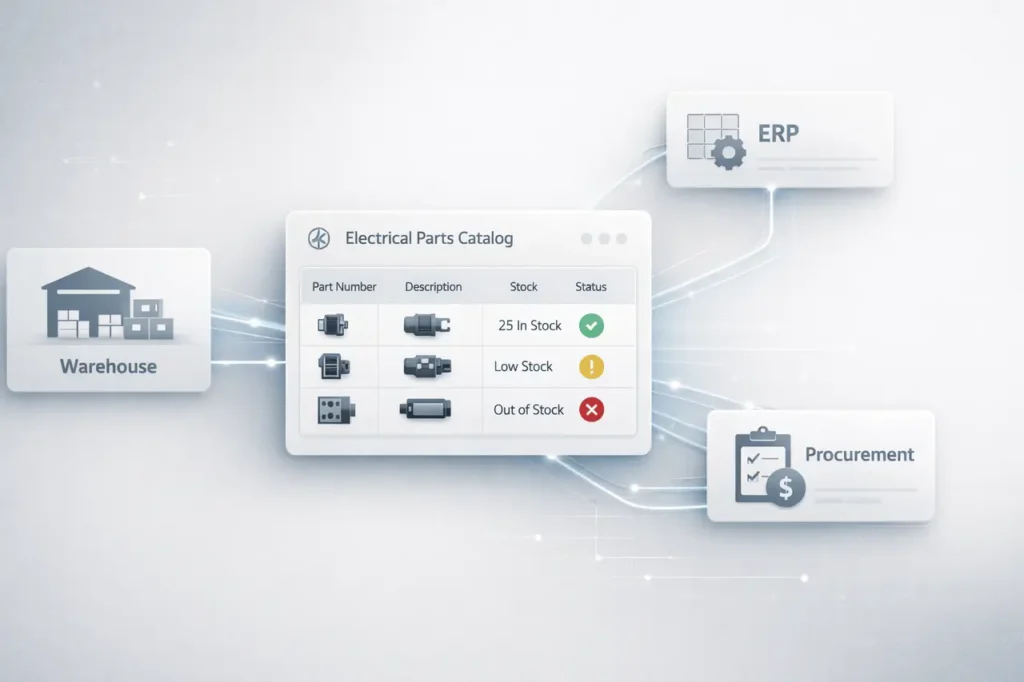
Live feed of parts availability through EPC integration allows companies to immediately access accurate information about inventory levels of products directly via the Electrical Product Catalogue (EPC). Through the integration of EPC systems with inventory management ERP, procurement, and inventory management platforms, businesses can make sure that inventory levels, availability of parts, and product information are always up-to-date.
In the industries that rely heavily on electrical equipment and parts, delays due to inaccurate inventory data can cause disruption to operations. EPC integration solves this issue through automated data synchronisation between inventory software and tools for the supply chain.
It results in better precision in procurement, quicker ordering processes, and improved decisions across maintenance and operations teams.
What is an Electrical Product Catalogue (EPC)?
The Electrical Product Catalogue (EPC) is an organised database of digital format that holds information on electronic components, spare parts, and other equipment.
These catalogues typically include:
- Part numbers
- Product descriptions
- Specifications for technical use
- Information on compatibility
- Manufacturer data
- Pricing and information on availability
Distributors, manufacturers, and service organisations depend upon EPC systems to guarantee accurate product identification and orders.
If EPC systems integrate with inventory and Supply Chain platforms, they are able to provide real-time availability feeds, which provide current stock status.
What Is a Real-time Parts Availability Feed?
Time-based feed of availability for parts feeds a data stream that constantly updates inventory status for components that are listed on EPC.
Instead of manually assessing levels of inventory or relying upon periodic updates, systems are able to receive instant inventory information when levels alter.
This permits:
- Procurement systems to display the current status of availability
- Team members of the Maintenance department are to confirm parts before placing an order
- Distributors to better manage supply
- Customers will be able to view exact information about the stock
The integration will ensure every connected system is using the most current information source.
How Real-time EPC Integration Works?
Real-time EPC integration connects various enterprise systems via an automated information exchange.
Core Integration Components
- EPC Database: Stores structured electrical product information.
- System for Managing Inventory: It tracks inventory movement and warehouse stock.
- ERP also known as Procurement Systems: It manages procurement workflows, supplier relationships and purchasing workflows.
- Integration Middleware or API layer: Enables communication between systems.
Typical Data Flow
- Inventory changes occur within the warehouse system.
- Stock data that has been updated is sent via APIs or middleware for integration.
- The EPC system is updated with information about availability.
- Connected systems retrieve real-time part availability.
This design assures that the product catalogues as well as procurement systems are always updated with the most recent inventory information.
Traditional Catalogue Systems vs Real-time EPC Integration
| Feature | Traditional Catalog Systems | Real-time EPC Integration |
|---|---|---|
| Inventory updates | Periodic manual updates | Automatic real-time updates |
| Data accuracy | Often outdated | Continuously synchronized |
| Ordering process | Manual verification required | Availability confirmed instantly |
| System connectivity | Limited integration | API-driven integration |
| Supply chain visibility | Partial | End-to-end visibility |
Contemporary EPC integration greatly enhances the reliability and speed of procurement procedures.
Key Benefits of Real-time Parts Availability Feed via EPC Integration
1. Improved Inventory Visibility
Companies get immediate information on the stock levels in storage facilities and distribution centres.
This allows teams to avoid purchasing parts that are not available.
2. Faster Procurement Decisions
Real-time information allows procurement teams to check the availability of parts in real time.
Orders can be placed without having to conduct a manual check of inventory.
3. Reduced Operational Delays
Maintenance operations are often dependent on the availability of spare parts in a timely manner.
Accurate EPC availability feeds prevent delay caused by missing components.
4. Better Data Consistency
The integrated systems ensure that all platforms use the same inventory and product information.
It minimises the mistakes caused by inconsistencies of information from different systems.
5. Enhanced Customer Experience
Service providers and distributors are able to present precise information about product availability to customers, thereby increasing transparency and confidence.
Real-world Use Cases
Real-time EPC integration can be used to support a wide spectrum of industries that depend on electric components as well as spare components.
| Industry | How Real-time EPC Availability Helps |
|---|---|
| Manufacturing | Ensures critical electrical components are available for production maintenance |
| Energy & utilities | Supports rapid replacement of electrical infrastructure parts |
| Industrial maintenance | Confirms spare parts availability before scheduling repairs |
| Electrical distribution | Provides accurate stock information for dealers and contractors |
| Facility management | Simplifies sourcing of electrical equipment and replacement components |
These applications demonstrate how precise catalogue data directly affects the efficiency of operations.
Challenges of EPC Integration
While feeds with real-time availability offer clear benefits, companies could face numerous challenges in implementing them.
Data Standardization
Electrical components catalogues might contain inconsistent names or identifiers for products.
Standardising product data is essential for successful integration.
System Compatibility
Older ERP or inventory systems require middleware or customised APIs for connection to EPC platforms.
Data Governance
Organisations should define clear rules to manage updates to product data and control versioning.
Without proper governance, data inconsistencies could reappear.
Infrastructure Requirements
Real-time synchronisation demands an efficient network connection and the ability to scale integration.
Practical Considerations for Implementing EPC Integration
Organisations looking to implement the real-time EPC integration should be focused on a number of key elements.
Establish a Unified Product Data Model
Utilising consistent parts numbers, attributes of the product and identifiers guarantees an efficient system of communication.
Use API-Based Integration
The latest EPC platforms typically have API connections that allow instantaneous data exchange.
API-driven integration increases the scalability and security.
Maintain Data Quality Controls
Validation on a regular basis of catalogue data stops inaccuracies from spreading through integrated systems.
Align Stakeholders Across Departments
Achieving EPC integration usually requires cooperation between
- IT teams
- procurement departments
- maintenance operations
- supply chain management
Cross-functional alignment assures that the integration meets the operational needs.
My Final Thoughts
Real-time availability feed for parts through EPC integration plays an essential function in supply chains of today that rely on electrical components as well as spare parts. Through the integration of Electrical Product Catalogues with inventory, ERP or procurement software, companies have immediate access to precise availability information.
This integration increases visibility of inventory, decreases delays in procurement, and ensures that operational teams have access to appropriate parts at the right moment.
While supply chain management continues to depend on electronic systems and automated process flow, EPC integration will remain vital to maintain precise product information and effective parts management across all industries.
FAQs
1. What is the real-time availability of parts feeds via EPC integration?
It is a platform that connects Electrical Product Catalogues with procurement and inventory platforms in order to offer continuously updated parts inventory information.
2. Why is EPC integration important for electrical components?
Electrical systems are often dependent on certain components. EPC integration guarantees accurate identification of the product and verification of availability prior to placing orders.
3. How does real-time EPC integration improve procurement?
It enables procurement teams to assess the availability of parts immediately, thus decreasing delays and stopping the ordering of parts that aren’t available.
4. Are EPC systems integrated seamlessly with ERP platforms?
Yes. A lot of EPC systems can be integrated with ERP or inventory control platforms using APIs or through middleware.
5. Which industries are most benefited by EPC access feeds?
Industries like manufacturing, utility, distribution of electricity and industrial maintenance profit from real-time availability data for parts.
6. What is the most difficult issue when implementing EPC integration?
The issues of data Standardization as well as system compatibility are common problems when integrating old enterprise systems.
Also Read –
Best Practices for Part Ordering via EPC
Building a Parts Quote Using EPC (Electronic Parts Catalog): A Step-by-Step Guide (2025)