
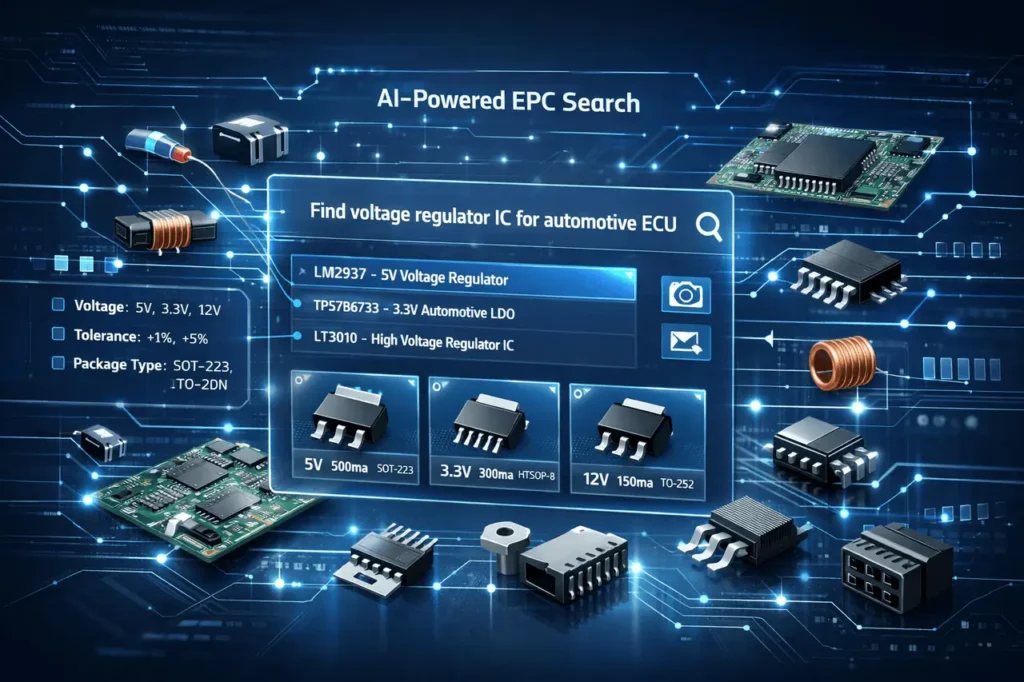
Electronic Parts Catalogues (EPCs) have been the mainstay of after-sales services procurement and field maintenance. The traditional EPC Search relies on precise part numbers, used in conjunction with rigid filtering, and on human understanding of vendor nomenclature, which can cause problems when part numbers aren’t complete, when photos are your only option, or when different vendors use different attributes. AI-powered EPC Search adds advanced techniques, including natural language understanding, vector (semantic) search, image search, domain models, and image matching over catalog data, to bridge gaps and guide users to the correct part faster.
In this article, we will explain AI-powered EPC Search, how it works, and why it is transforming electronic parts discovery for engineers, service teams, and procurement professionals.
Core Capabilities of AI-Powered EPC Search
- Semantic/Vector Search: (Natural-Language understanding) instead of finding actual terms, AI maps queries and part records to high-dimensional vectors to ensure that phrases such as “low-noise 3.3 V regulator for small sensors” return relevant parts, even if the exact phrasing isn’t in the inventory. This reduces the number of failed searches and also helps people who are not experts in the field find parts with the intention.
- Hybrid and Parametric Filtering: AI complements semantic results by using parametric filters (package voltage, temperature, life-cycle state). A reliable AI EPC surfaces semantically relevant options and enables engineers to make decisions based on precise mechanical, electrical, and commercial properties.
- Images and Visual Search: Take a photo of the PCB’s footprint, connectors, or even a discrete part, and the AI Visual Search model can suggest matches based on the EPC, typically using exploded views in 2D/3D and hotspots to verify the game. This can be a game-changer in cases where part numbers aren’t easily read.
- Data Enhancement and Entity Linking: AI can normalise vendor names, map alternate manufacturer part numbers (MPNs), extract attributes and information from diagrams or PDFs, and connect items in Bills of Materials (BOMs) and service manuals, as well as cross-reference lists, increasing recall and decreasing duplicate SKUs.
- Contextual Assistance and Recommendations: Beyond matching, some systems will suggest alternative products with similar specifications, highlight lifecycle and lead-time risks, or prioritize distributors with in-stock items to help procurement make quicker, safer decisions.
Value for business: What businesses actually benefit from?
- Speedier Mean Time to Repair (MTTR): Service technicians and field technicians locate the correct part more quickly, decreasing downtime and enhancing SLA performance.
- Lower Procurement Friction: Semantic search reduces time spent on back-and-forth clarifications and manual cross-referencing. Integration with distributors’ inventory (pricing/lead times) helps speed up purchasing cycles.
- More Accurate Returns and Fewer Misorders: Visual confirmation, improved attribute extraction, and recommendation logic can reduce shipments with wrong parts.
- Monetization of Aftermarket Channels: It is easier to find dealers and secondary channels to convert inquiries into parts sales.
Patterns of implementation and techniques
The latest AI EPCs typically combine elements rather than being a monolithic unit:
- Indexing Pipeline: Extract structured attributes from manufacturer BOM data sheets, diagrams, and images, and standardize fields (footprint voltage, footprint tolerance, manufacturers).
- Embeddings + Vector Store: Create embeddings for text descriptions and taxonomy nodes; store them for closest-neighbor search (vector searches).
- Vision Models: Utilise trained convolutional or transformer-based encoders to identify photographs against illustrations and parts images.
- Business Rules and Parametric Filters: Apply deterministic filters to meet regulatory compliance requirements, such as footprint compatibility and procurement rules.
- Integrations: Real-time inventory-distributor APIs, PLM/ERP/BOM systems, and service manuals provide live context for search results.
AI-Powered EPC Search: Real-world vendors & examples
Search engines and platforms such as Octopart demonstrate the parametric/availability combination that procurement teams rely on. Niche EPC integrators and vendors (Intelli Catalog Components Engine, spareparts. live, and others) are introducing AI features such as visual match-ups, conversational query layers, and automatic attribute extraction to streamline technicians’ workflows. Independent projects and consultancy services (such as recent AI search agents for electronic parts) demonstrate that this is an area in development.
Specific Limitations and Practical Limitations
- Data Quality is the Primary Issue: AI is only as effective as the manuals and catalogs it consumes. Incoherent or inconsistent metadata (mislabelled attributes, missing images) can decrease precision and lead to more false positives. Complete cleansing and data mapping remain essential.
- Model Hallucination Risks: Generative or semantic layers should not create specifications; the results must be traceable to attribute provenance and clearly linked to source documents. Good interfaces explain why a part is a match (keywords or attributes, image similarity).
- Lifecycle and Commercial Risks: AI may recommend obsolete or long-lead products unless the lead-time and lifecycle data are actively monitored and surfaced. Integration with distributor/obsolescence feeds is required.
Best Practices to adopt AI within your EPC
- Begin by implementing a pilot program for a high-value subset (e.g., critical assemblies, high-return zones) to test MTTR and the benefits of procurement.
- Ensure the data hygiene process normalises MPNs, supplier names, footprints, and images before embedding.
- Use a hybrid search UX, combine conversational/semantic query boxes with visible parametric filters and image upload.
- To maintain the traceability of your document, always be able to show which document or attribute created the match to avoid relying too heavily on AI.
- Assess the outcomes (search rates, resolution time, or return of the wrong part) and then repeat.
My Final Thoughts
AI-powered EPC Search is no longer an abstract improvement, but a real-world productivity boost for engineering, service, and procurement departments. When implemented with careful data maintenance, traceability, and a hybrid UX (semantic and parametric), AI reduces time to identify parts correctly, reduces the misorder rate, and increases aftermarket revenue. Businesses that view integrity and data integration as top-of-the-line issues will experience the fastest, most efficient benefits from AI in EPC workflows.
FAQs: AI-powered EPC Search
1. How is semantic (vector) search different from keyword search for parts?
The keyword search matches tokens literally. In contrast, the semantic (vector) search transforms phrases and records into embedded snippets that capture the meaning of words and can identify intent and related concepts even when exact words are not identical. This is particularly useful when users explain the function rather than MPNs.
2. Can AI reliably identify a part from a photo?
Modern visual search tools offer solid candidate matches based on photographs, CAD, and exploded views; however, accuracy depends on the quality of the images and the extent of catalog image coverage. The combination of visual matching with attribute filters and manual confirmation can yield the best results.
3. Will AI replace human engineers in parts selection?
No. AI enhances discovery and opens new possibilities, but experienced engineers are still required to validate trade-offs, conduct regulatory compliance audits, and make final procurement decisions. AI helps reduce repetitive tasks and supports decision-making.
4. Which data sources are best added to the AI EPC?
Manufacturer datasheets, distributor inventories (price/lead time), BOMs, service manuals/illustrations, PLM/ERP records, and historical repair orders. The quality and reliability of these resources directly affect the effectiveness of searches.
5. Is an AI EPC secure for sensitive product data?
Security is a standard for deployment in private or on-premises cloud configurations, role-based access, and encrypted storage. Check your vendor’s compliance with your company’s and regulatory requirements before integration.
Also Read –
Electronic Parts Catalogue (EPC) Comparison: Tool A vs Tool B