
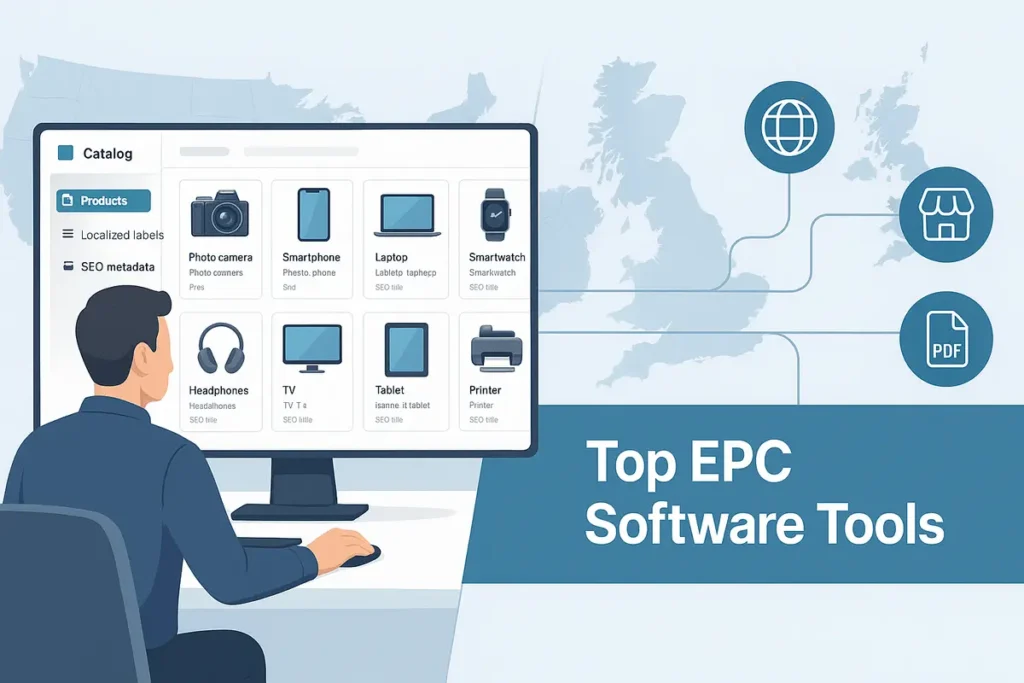
In the rapid-paced world of e-commerce as well as digital retail, managing Electronic catalogues of products (EPC) is an important challenge for businesses. EPC software, specialised tools for centralising, enriching, and distributing product information across channels–ensures accurate, consistent data for online stores, marketplaces, and print catalogues. As we approach 2025 with omnichannel selling dominating and AI-driven personalised selling increasing, the most effective EPC solutions are ones which seamlessly integrate with platforms such as Shopify, Amazon, and Magento, as well as incorporate international compliance standards such as GDPR as well as CCPA.
This thorough review concentrates on the Best EPC software tools made by American-based firms that are ideal for users across countries like the USA, UK, Canada and further. We’ve chosen these in accordance with user ratings of G2 as well as Gartner (4.5and five stars) and feature the depth needed for catalogue management in electronic format, the ability to scale for SMBs to enterprise-sized businesses and 2025-specific updates, such as AI enhancements.
If you’re a manufacturer that is syncing information to Walmart as well as a retail store focusing on mobile sales, these apps can aid in streamlining your processes and increasing conversions.
What Is EPC Software?
EPC software refers to digital platforms that manage and distribute product information, including specifications, images, pricing, and availability. Unlike traditional paper catalogs, EPC software offers real-time updates, interactive features, and seamless integration with other business systems. This digital transformation enhances accuracy, reduces manual errors, and improves the overall customer experience.
A Quick Buyer Summary
If you need an enterprise-grade, global catalog + syndication platform: Syndigo (post-Riversand consolidation) or Informatica are top choices.
If you want a product-first PXM / catalog tool with strong retailer syndication and DIY catalogs: Salsify.
If you’re a U.S. manufacturer or distributor seeking a US-built, mid-market PIM + eCatalog: Catsy.
If you need catalog features integrated with a broader ERP/PLM/SCM stack, consider Oracle Product Hub / Fusion Cloud.
Why EPC Software Matters in 2025
Electronic product catalogs form the foundation of modern commerce. A poor quality of data can result in 30% abandonment of carts (per Forrester), while robust EPC systems can boost sales by about 15 % through improved SEO and personalised experience.
The key trends for 2025 are:
- AI-Powered Enrichment: Auto-generating pictures and descriptions.
- Omnichannel syndication: One-click publishing for 1500+ retailers.
- Sustainable Tracking: Acronyms for claims about eco-friendly practices.
- The Integration Ecosystem: Native connections to ERP CRM, CRM, and DAM tools.
The US-based companies excel in this area with their support and services, which are robust in data sovereignty, as well as conformity in accordance with North American regulations.
Selection Criteria for Our Top Picks
We evaluated 50+ tools using:
- User Reviews: Aggregated from G2, Capterra, and Gartner (2025 data).
- Features: Core EPC functions like data import/export, variant management, and analytics.
- Pricing Transparency: Value for money, with free trials.
- USA Focus: Headquarters in the US for local support and innovation.
- Scalability: Handling 10K-1M+ SKUs.
Ratings are out of 5 stars (averaged across sources).
Top 10 Best EPC Software Tools in 2025

1. Salsify – Best Overall for Omnichannel Syndication
Headquartered in Boston, MA, Salsify leads the pack with its Product Experience Management (PXM) platform, evolving EPC into a full digital shelf optimiser. It’s perfect for brands selling on Amazon, Walmart, and Target.
Key Features:
- AI-driven content scoring and auto-enrichment for descriptions/images.
- One-click syndication to 1,500+ retailers and marketplaces.
- Digital shelf analytics for conversion tracking and competitor insights.
- Built-in DAM for asset management and workflow approvals.
Pros:
- Intuitive UI with low learning curve.
- Strong US retailer integrations (e.g., Walmart API).
- AI updates in 2025 boost personalization by 25%.
Cons:
- Advanced analytics require add-ons.
- Best for mid-to-large teams (10+ users).
Pricing: Starts at $5,000/month (enterprise tiers); 14-day free trial. Custom quotes for SMBs.
Best For: US/UK e-commerce brands with 5,000+ SKUs. G2 Rating: 4.7/5 (1,200+ reviews).
2. Syndigo – Best for Retail Compliance and Data Governance
Based in Chicago, IL, Syndigo’s Content Experience Hub combines PIM, DAM, and MDM for regulated industries like CPG and electronics. It’s a go-to for Canadian exporters needing GTIN compliance.
Key Features:
- 250K+ product attributes with regulatory validation (e.g., FDA labeling).
- Real-time alerts for data quality issues and vendor scoring.
- Bulk editing via Excel imports and API syndication.
- Analytics for SKU performance across channels.
Pros:
- Excels in B2B/B2C hybrid catalogs.
- Free content creation services for onboarding.
- 2025 updates include AI for image tagging.
Cons:
- Pay-per-SKU model scales costs for large catalogs.
- Interface feels dated for non-enterprise users.
Pricing: Custom (from $6,000/month based on SKUs); demo available, no free trial.
Best For: Manufacturers in the USA/Canada targeting big-box retailers. Gartner Rating: 4.6/5 (800+ reviews).
3. Acquia DAM (Widen) – Best for Integrated DAM and EPC

From Boston, MA, Acquia’s Widen (now part of Acquia DAM) blends EPC with digital asset management, ideal for creative teams building interactive catalogs.
Key Features:
- Flexible metadata for 360° product views and videos.
- Role-based workflows and brand portals for self-service.
- E-commerce connectors (Shopify, Magento) for dynamic feeds.
- Predictive search and version control for assets.
Pros:
- Seamless DAM-PIM integration reduces silos.
- Strong for UK/EU compliance with GDPR tools.
- 2025 AI add-ons for auto-tagging assets.
Cons:
- PIM features require expansions (extra cost).
- Less focus on pure syndication analytics.
Pricing: From $4,000/month; free demo, scalable add-ons.
Best For: Marketing-heavy teams in creative industries. G2 Rating: 4.5/5 (900+ reviews).
4. Precisely EnterWorks – Best for Enterprise MDM-Enabled EPC
Headquartered in Sterling, VA (part of Precisely), EnterWorks offers robust master data management fused with EPC, suiting complex supply chains.
Key Features:
- AI/ML for data enrichment and anomaly detection.
- Multi-domain support (products, suppliers, customers).
- Custom workflows and B2B portal syndication.
- Integration with SAP/Oracle for ERP sync.
Pros:
- Handles massive datasets (1M+ SKUs) with high security.
- Proven in North American manufacturing.
- 2025 enhancements for sustainability attribute tracking.
Cons:
- Steep implementation (3-6 months).
- Overkill for small catalogs.
Pricing: (starts at $10,000/month); custom enterprise quotes.
Best For: Large US enterprises with global ops. Gartner Rating: 4.6/5 (600+ reviews).
5. Feedonomics – Best for Marketplace Feed Optimization
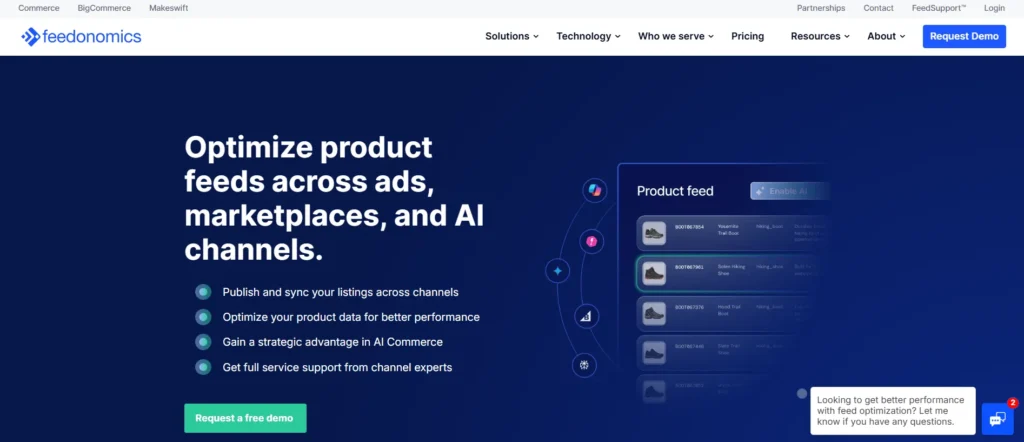
Austin, TX-based Feedonomics specializes in product feed management as an EPC extension, optimizing catalogs for Amazon, Google Shopping, and eBay.
Key Features:
- Automated feed creation and error monitoring.
- Rule-based mapping for 1,000+ attributes.
- Performance analytics for feed health.
- Integrations with PIMs like Salsify.
Pros:
- Affordable entry for SMBs.
- Quick setup (under 2 weeks).
- 2025 AI for dynamic pricing feeds.
Cons:
- Less full PIM (focus on feeds).
- Limited DAM capabilities.
Pricing: From $500/month (pay-per-feed); 30-day free trial.
Best For: Growing UK/Canada sellers on marketplaces. G2 Rating: 4.8/5 (400+ reviews).
6. 1WorldSync – Best for Global Data Synchronisation
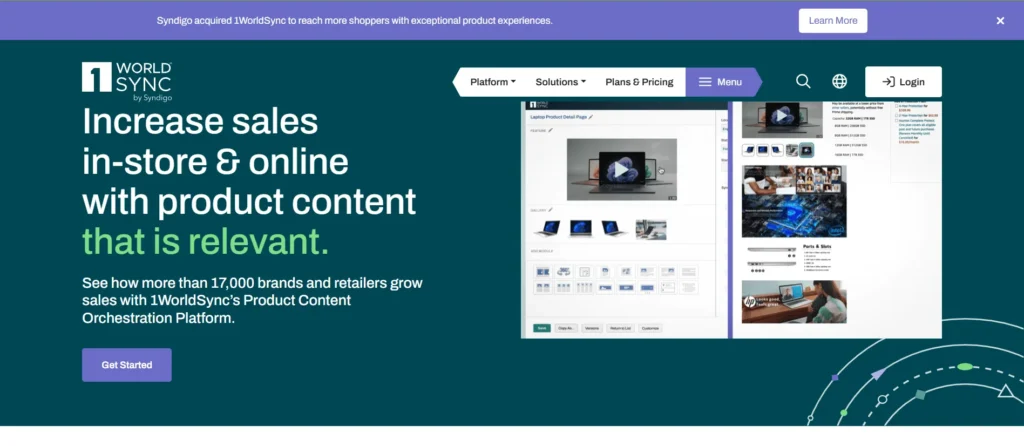
Based in Chicago, IL, 1WorldSync excels at orchestrating product content, which makes it the ideal solution for companies that require standard data across global distribution chains.
Key Features:
- Global Data Synchronisation Network (GDSN) for real-time updates.
- Metadata enriched with specifications, images, and GTINs.
- Version control and workflow automation.
- API integrations with ERP and e-commerce platforms.
Pros:
- Powers over 85% of top brands to meet compliance.
- Cuts down time-to-market by up to 75 75%.
- Strong analytics for error reduction (68% average).
Cons:
- User Interface has a steep growing curve.
- Premium features add costs.
Prices Custom (from $3,000 per month) Free demo.
The best for CPG and retail that has global operations. G2 Rating: 4.6/5 (700+ reviews).
7. PIMworks – Best for Rapid Implementation and SMB Scalability
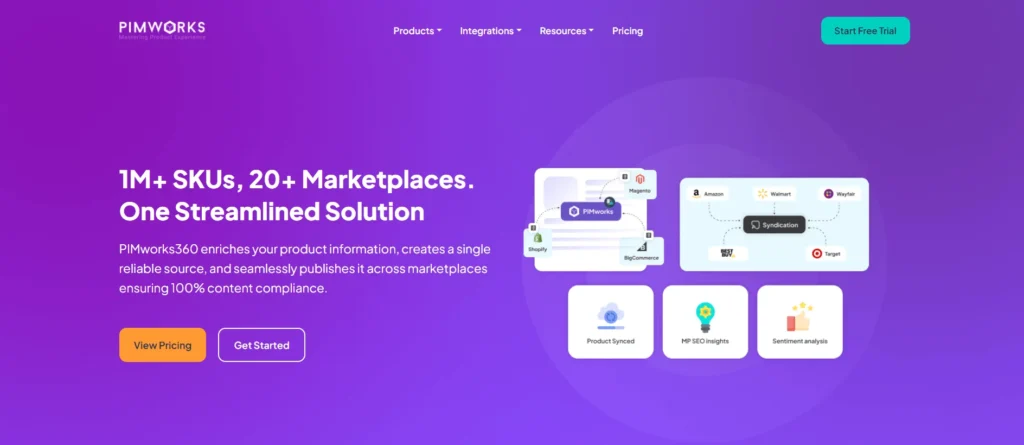
New York, the NY-based PIMworks provides a user-friendly platform for easy setup, which is ideal for the rapidly growing e-commerce team.
Key Features:
- AI-powered data enrichment and SEO optimisation.
- Multichannel syndication for 20plus marketplaces.
- The bulk update and Asset management.
- Templates are prebuilt to import data into ERP systems.
Pros:
- Fast onboarding (under 4 weeks).
- Affordable for small and medium-sized businesses with support for 1M+ SKUs.
- 2025 AI enhancements for content generation.
Cons:
- Advanced, limited governance for companies.
- Fewer native B2B tools.
Prices Pricing: Starting at $69/month. You get a 14-day no-cost trial.
The best choice for small businesses that want to scale online sales. G2 Rating: 4.7/5 (300+ reviews).
8. Unbxd PIM – Best for AI-Driven Search and Personalisation
San Mateo, CA-based Unbxd combines EPC with AI to provide superior product discovery and is compatible with the data-rich catalogues.
Key Features:
- AI tagging and real-time personalisation.
- Search optimisation and variant management.
- Integrates with Shopify as well as BigCommerce.
- Analytics for conversion insights.
Pros:
- Enhances search relevancy by 30 per cent.
- Evolving AI features in 2025.
- Strong for mobile-first experiences.
Cons:
- Ideal for large data sets.
- Governance features are still maturing.
Pricing: From $1,000/month; demo available.
The best for retailers focused on UX. G2 Rating: 4.5/5 (500+ reviews).
9. Bluestone PIM – Best for Fashion and Variant-Heavy Catalogues
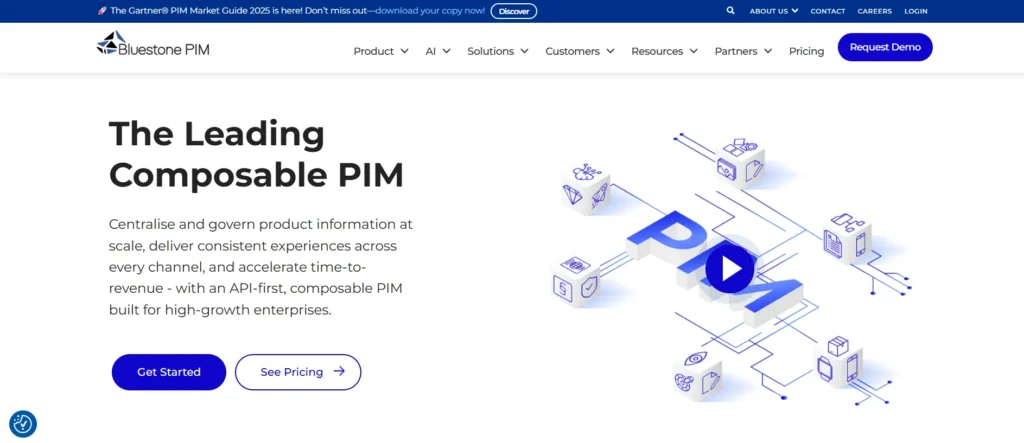
Austin, Texas-based Bluestone is a specialist in clothing and seasonal merchandise, which includes integrated PLM.
Key Features:
- Seasonal and Variant Management.
- Integrated PLM for lifecycle tracking.
- Specific attributes for fashion and workflows.
- API for custom e-commerce ties.
Pros:
- A custom-designed solution for specific industry requirements.
- Reduces the time to launch by 40 per cent.
- Expert support for creatives.
Cons:
- Less versatile outside fashion.
- More expensive in non-apparel.
Pricing: $1,000-$5,000/month; custom quotes.
The Best for: Brands of apparel in the United States and the UK. G2 Rating: 4.6/5 (400+ reviews).
10. Katana PIM – Best for Manufacturing SMBs
Based out of Tampa, FL, Katana incorporates EPC along with inventory management tools for makers as well as distributors.
Key Features:
- Inventory-integrated data management.
- Production workflows, forecasting and production.
- Channel editing in bulk and syndication.
- ERP connectors like QuickBooks.
Pros:
- Budget-friendly for SMBs.
- Reduces manual labour by 50 per cent.
- 2025 updates to track sustainability.
Cons:
- Limited enterprise scalability.
- Smaller integration library.
Pricing: Under $1,000/month; free trial.
Ideal for: US manufacturers with inventory requirements. G2 Rating: 4.4/5 (250+ reviews).
Quick Comparison: Best EPC Software Tool at a Glance
Scroll horizontally to view all 10 tools on desktop. Fully mobile-friendly design.
| Feature/Tool | Salsify | Syndigo | Acquia Widen | Precisely EnterWorks | Feedonomics | 1WorldSync | PIMworks | Unbxd | Bluestone PIM | Katana PIM |
|---|---|---|---|---|---|---|---|---|---|---|
| Core EPC Functions | Syndication, AI Enrichment | Governance, Analytics | DAM Integration | MDM Workflows | Feed Optimization | Data Sync | Rapid Implementation | AI Search | Variant Mgmt | Inventory Integration |
| Integrations | 1,500+ (Amazon, Walmart) | 1,000+ Retailers | Shopify, Magento | SAP, Oracle | Google, eBay | GDSN, ERP | 20+ Marketplaces | Shopify, BigCommerce | PLM APIs | QuickBooks, ERP |
| AI Capabilities | Content Scoring | Image Tagging | Auto-Tagging | Anomaly Detection | Dynamic Pricing | Metadata Enrichment | Content Generation | Personalization | Seasonal Forecasting | Workflow Automation |
| Scalability (SKUs) | 100K+ | 500K+ | 50K+ | 1M+ | 10K+ | 1M+ | 1M+ | 500K+ | 200K+ | 50K+ |
| Pricing (Starting) | $5,000/mo | $6,000/mo | $4,000/mo | $10,000/mo | $500/mo | $3,000/mo | $699/mo | $1,000/mo | $1,000/mo | $500/mo |
| Free Trial/Demo | 14 days | Demo | Demo | Custom | 30 days | Demo | 14 days | Demo | Custom | Free Trial |
| G2 Rating (2025) | 4.7 | 4.6 | 4.5 | 4.6 | 4.8 | 4.6 | 4.7 | 4.5 | 4.6 | 4.4 |
| Best Audience | USA E-com Brands | Regulated Industries | Creative Teams | Enterprises | Marketplace Sellers | Global CPG | Scaling SMBs | UX-Focused Retail | Fashion Brands | Manufacturers |
Tip: Scroll → to see all columns
How do you choose the best EPC Software (For the US/UK/Canada regions)
1. Budget and TCO: Enterprise PIM/MDM has higher implementation and ongoing costs. It also includes the cost of training and connectors, as well as enriching content.
2. Choose your scope: Marketing-led catalogues (Salsify, Catsy) vs. enterprise MDM plus syndicating (Syndigo, Informatica).
3. Network Needs: Needs of the network or retailer to supply large retailers in Canada and the US/UK (Walmart, Home Depot, Amazon, Wayfair), ensuring that the vendor has syndication coverage as well as connectors.
4. Connectivity points ERP (Oracle, SAP) and commerce platform (Magento, Shopify, Salesforce Commerce), DAM, and MDM.
5. Data Governance: Complex SKUs, multi-domain product information, as well as information about regulatory requirements — use Informatica and Syndigo.
6. Time to market and team: Marketing teams generally would prefer Salsify or Catsy for self-service catalogues that are faster.
Checklist for implementation (practical steps)
- Sources of current inventory information on products and channels.
- Create a minimum viable catalogue template and export it from existing systems.
- Conduct a pilot aboard 50-100 SKUs, to test enrichment, ingestion and publishing.
- Validate the syndication workflows for every retailer channel that is required.
- Train both supply-chain and marketing teams in governance and workflows.
- Measure: time-to-publish, error rates, conversion uplift on enriched SKUs.
What to determine?- ROI
- Timing to Market (new SKU publish time).
- Catalogue errors/returns reduction.
- An increase in the digital shelf score or search findability.
- Conversion lift for enriched SKUs vs baseline.
- Reduction of manual labour (hours saved during Content updates).
My Final Recommendations –
If you are a retailer and syndication as well as enterprise-grade master data management (MDM), are your most important goals, Syndigo is the perfect choice. It is a single PIM and MDM platform for large businesses that need to manage complicated data about products and distribute it across the major U.S. and global retailers.
For teams that are driven by marketing and focusing on creating catalogues quickly and publishing across all channels, Salsify and Catsy are the best choices. Salsify offers flexible, no-code catalogue tools as well as robust marketplace syndication. In contrast, Catsy is a reliable printer and PDF catalogues -perfect for U.S.-based distributors and manufacturers that require fast, customised outputs.
If your company is concerned about data accuracy, accountability and compliance over all else and foremost, you should consider Informatica Product 360 or Oracle Product Hub (Fusion Cloud) are the most trustworthy alternatives. Both offer enterprise-level control and integration, with Informatica excelling in terms of the quality of data, and Oracle providing seamless connectivity to their ERP system and the supply chain systems.
In simple terms, Syndigo is a great syndication tool and can scale up, Salsify, as well as Catsy, to speed up and increase agility in marketing, as well as Informatica and Oracle to manage data and governance accuracy.
FAQs
What exactly is EPC software? And why will I require it by 2025?
EPC (Electronic Product Catalogue) software centralises information about products to allow digital distribution. By 2025, it will be essential to ensure AI personalised services and seamless scalability, which will reduce the chance of errors by up to 40% and increase SEO rankings.
Are these EPC tools suitble for non-US audiences like the UK and Canada?
All are based in the United States, but they are globally accessible thanks to the GDPR/CCPA, multi-language support, as well as regional integrations with retailers (e.g., Salsify for Tesco in the UK).
What is the price of the top EPC software set in 2025?
The entry-level plan starts at $500/month (Feedonomics). Enterprise levels reach $10,000+ per month. The majority of them offer demos; anticipate 20% savings through annual billing.
What is the timeline for implementing EPC software?
SMBs: 2-4 weeks. Enterprises: 3-6 months. USA providers such as Salsify provide free onboarding to help you achieve a more rapid ROI.
Can EPC software be integrated with my current E-commerce platform?
Absolutely. Top tools can connect with Shopify, BigCommerce, and Magento straight out of the box, and include APIs to meet your specific needs.
What EPC tool is most suitable for novices?
Feedonomics and Acquia Widen with user-friendly interfaces and trials for free.