

The auto industry is experiencing the rapid transformation of digital technology. From online research on vehicles through remote finance approvals, customers are now expecting seamless, personal experiences throughout their journey. Car dealerships must adapt to this new expectation, which requires far more than the traditional sales methods and requires intelligent management of data, instant insight, and consistent interaction across many points of contact.
This is the point at which Customer Relationship Management (CRM) systems are able to help. They were once thought of as just electronic contact books; today’s automotive CRMs have developed into AI-driven, intelligent platforms that oversee all aspects of the dealer-customer relationship, from lead generation to nurture to after-sales services and retention.
In this article, we’ll explore how CRM Systems for Automotive Dealers improve operational efficiency and what key benefits they bring to the dealership ecosystem.
Let’s dive in….
What is a CRM System for the Automotive Dealers Industry?
A CRM (Customer Relationship Management) system is a central platform that assists dealers in managing interactions with potential and current customers. It monitors every lead, including website inquiries as well as social media marketing campaigns, phone calls, and walk-ins, and ensures that no lead slips by unnoticed.
In a car context, CRMs aren’t solely about tracking contacts. It is integrated with sales, marketing, as well as finance, service, and departments, which allows teams to:
- Follow the lead activity and identify buyers with high interest.
- Follow up with a specific person based on their experience.
- Automate repetitive workflows such as scheduling reminders for test drives or appointment bookings.
- Review the effectiveness of campaigns and sales in real-time.
Modern CRM systems, such as VinSolutions, Elead, or AutoAlert CXM, have been using the power of predictive analytical techniques along with artificial intelligence-driven modeling of data, making simple lead databases into sales tools that are proactive.
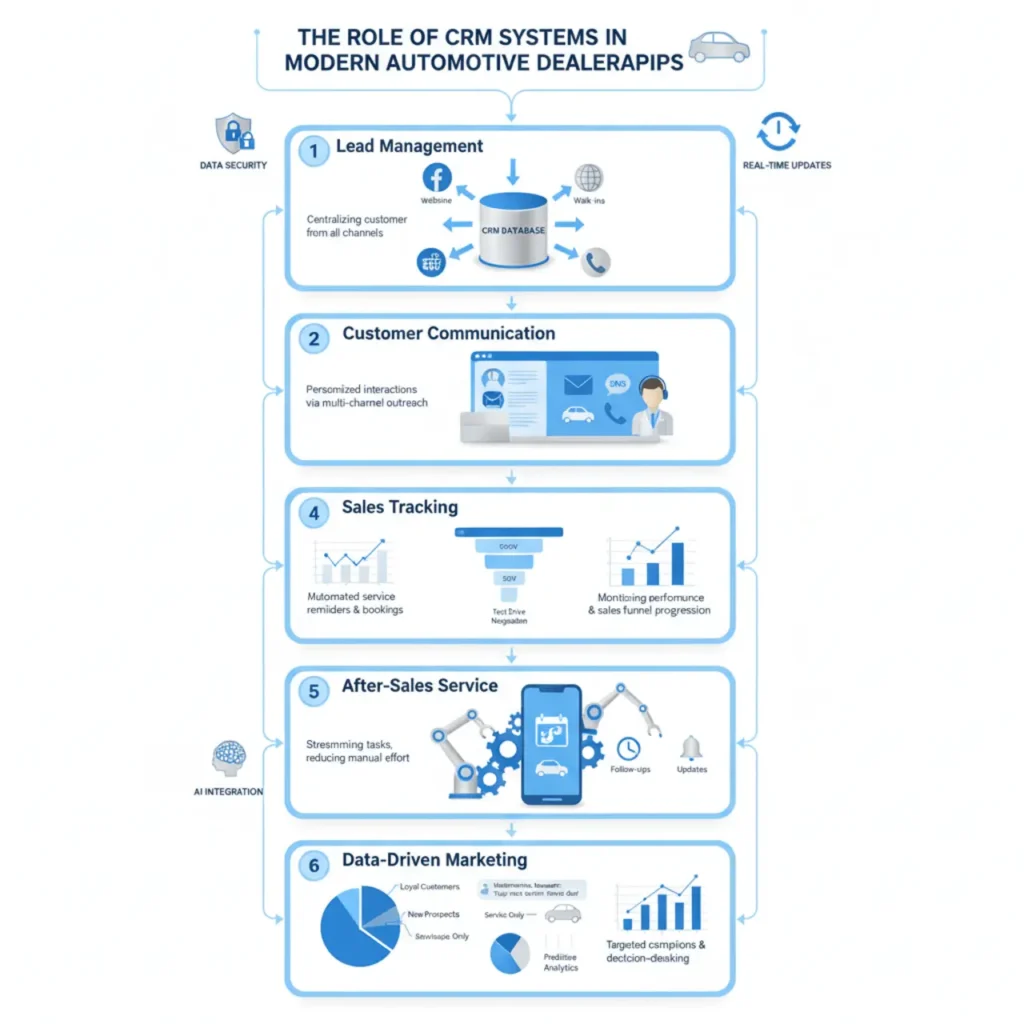
Why can’t Automobile Dealers be successful without a CRM?
1. Centralized Lead Management
Every business receives leads from a variety of sources, such as the website and third-party marketplaces, walk-ins, social media, or even referrals. Without an organized system, it’s almost impossible to keep track of, qualify, and follow up with each lead promptly.
A CRM consolidates all of these leads into one dashboard, which automatically assigns them to sales reps and monitors progress through the sales funnel. Through real-time lead alerts and score scoring, sales representatives are able to focus on leads that are most likely to convert, decreasing response times and increasing opportunities for sales.
2. Personalized Customer Communication
Modern customers demand more than generic communications. CRMs store detailed data on each customer’s preferences for their vehicle, past interactions, and service information, allowing dealers to send highly targeted, customized messages.
It could be a reminder for service, a birthday message, or a promotion to celebrate the upcoming launch of a model. The CRM automation will ensure that every customer is valued and appreciated. Personalization doesn’t just increase satisfaction but also helps build lasting loyalty.
3. Automation to Improve Efficiency
Dealerships are responsible for thousands of repetitive tasks every day, including following up with leads, scheduling test drives, sending reminders for service, and many more. CRMs automate these processes, leaving service and sales teams to concentrate on what is most important: closing deals and maintaining relationships.
Automation minimizes human error, ensures communications consistency, and guarantees there is no chance of loss because of human oversight.
4. Predictive Analytics and Real-Time Data
One of the most significant benefits that modern CRMs have is predictive intelligence. By studying customer behaviour, service patterns, and market information, CRMs are able to predict the time a client is looking to sell their vehicle or when a lease is approaching expiration.
For example, systems such as AutoAlert CXM automatically alert sales representatives about customers who are in the market and who are statistically more likely to purchase within the next few days. This proactive approach changes the way dealerships develop their sales strategy, shifting from reactive selling to predictive selling.
5. Seamless Marketing Integration
CRM systems do more than just handle data; they can also increase marketing’s impact. Integrating with platforms for marketing automation enables dealers to create segments of their customers, send out SMS or email campaigns, and track engagement metrics directly in the CRM.
For instance, when a consumer explores SUVs online, the CRM could generate targeted ads featuring similar vehicles or financing options. This approach is based on data to ensure that the marketing budget is effectively spent.
6. Better after-sales service and retention
The actual value for dealerships is retention and service, as well as car sales. CRMs play a crucial function in ensuring long-term customer engagement by monitoring maintenance schedules, sending reminders, and managing loyalty programs.
Customers who are provided with timely updates on their service and relevant deals are more likely to return for more purchases in the future and thus create a loop of referrals and repeat business.
7. Better Departmental Collaboration
Traditional dealership systems usually create data silos that separate sales, service, and finance departments. CRM integration helps bridge this gap through a more unified view of the entire customer journey.
Service advisors have access to the purchase history of customers. Sales teams can review the service history, and marketing can monitor interactions across different channels. This transparency helps ensure that every department strives to achieve a common objective of improving customer service.
Beginning to Next-Gen: The Development of Automotive CRMs
Early CRM systems primarily stored static contact data and recorded interactions. Modern CRM systems are flexible and intelligent, and are equipped with the ability to automate, AI insights, and integration capabilities that connect each area in the showroom.
Modern platforms, like AutoAlertCXM, show this trend through predictive modeling, automatic updates to data, and proactive alerts that aid teams in anticipating customer demands before they occur.
CRMs do more than manage relationships; they provide opportunities by ensuring that dealers are always ahead of customers and offering timely solutions.
How CRMs can optimize customer journeys
A customer’s journey through the auto industry can be long and complex, including tests, research, financing, servicing, and trade-ins. A CRM can map the entire process, allowing dealers to provide consistent and relevant experiences for every step of the process:
- Sensitivity: Capture leads through web forms and online campaigns.
- Take into consideration: Track engagement metrics and tailor follow-ups to your needs.
- Purchase: Reduce the burden of financing sales and documents using CRM workflows.
- Ownership: Maintain maintenance and survey results.
- Keep in touch: Offer loyalty rewards and trade-in offers at the appropriate moment.
This unifying understanding of the customer’s journey can help dealers shift from transactional sales to relationship-driven models.
The Business Effects of CRM Adoption
Dealers in the automotive industry who successfully implement CRM systems have seen results in measurable ways, which include:
- Higher Conversion Rates: A streamlined lead management system improves efficiency and leads to more successful sales.
- Enhances Customer Retention: Personalized engagement helps keep customers loyal and helps reduce the likelihood of them becoming churned.
- Improved Forecasting: The accuracy of the data is essential to better forecasts of sales as well as inventory management.
- Operating Efficiency: Automation reduces the administrative work and improves productivity.
In short, CRMs transform data into revenue, which is a competitive advantage in a highly competitive market.
Best Practices and Challenges for Implementation
While the adoption of CRM is transformative, it is dependent on the correct implementation. The most common issues are issues with data entry, inconsistencies in data entry, poor integration with other systems, and a lack of training for employees.
Good practices comprise:
- Selecting a CRM for automotive use with departmental integration across multiple departments.
- Offering a thorough onboarding process and ongoing training.
- Set clearly defined KPIs for CRM usage and accountability.
- Always updating data to ensure precision and security.
If it is implemented in a strategic manner, CRM implementation can yield quick returns on investment both in terms of financial and operational.
Choose Right Customer Relationship Management (CRM) for your Dealership
The process of selecting an automotive CRM requires considering factors such as scalability, the ability to integrate, user-friendliness, and price. Choose a platform that has AI features such as mobile access and strong security to protect your data. The most popular options are Salesforce Automotive CRM, VinSolutions, and CDK Global, each offering specific solutions. Demonstrate your products and think about vendor support that is in line with the objectives of your dealership.
It is the Future of Automotive CRM
The new generation of CRM software is developed by machine learning, artificial intelligence, and connected automotive technology. Predictive analytics will continue to evolve, providing real-time insight into the intent of customers and the health of vehicles.
Future CRMs will incorporate IoT information from connected vehicles, automating maintenance scheduling, anticipating parts replacements, and suggesting upgrades. Natural language and voice assistant interfaces will make CRM use easier for staff members at dealerships.
In the end, the CRM of the future will not just manage relationships, but it will manage the customer experience both through physical and digital channels.
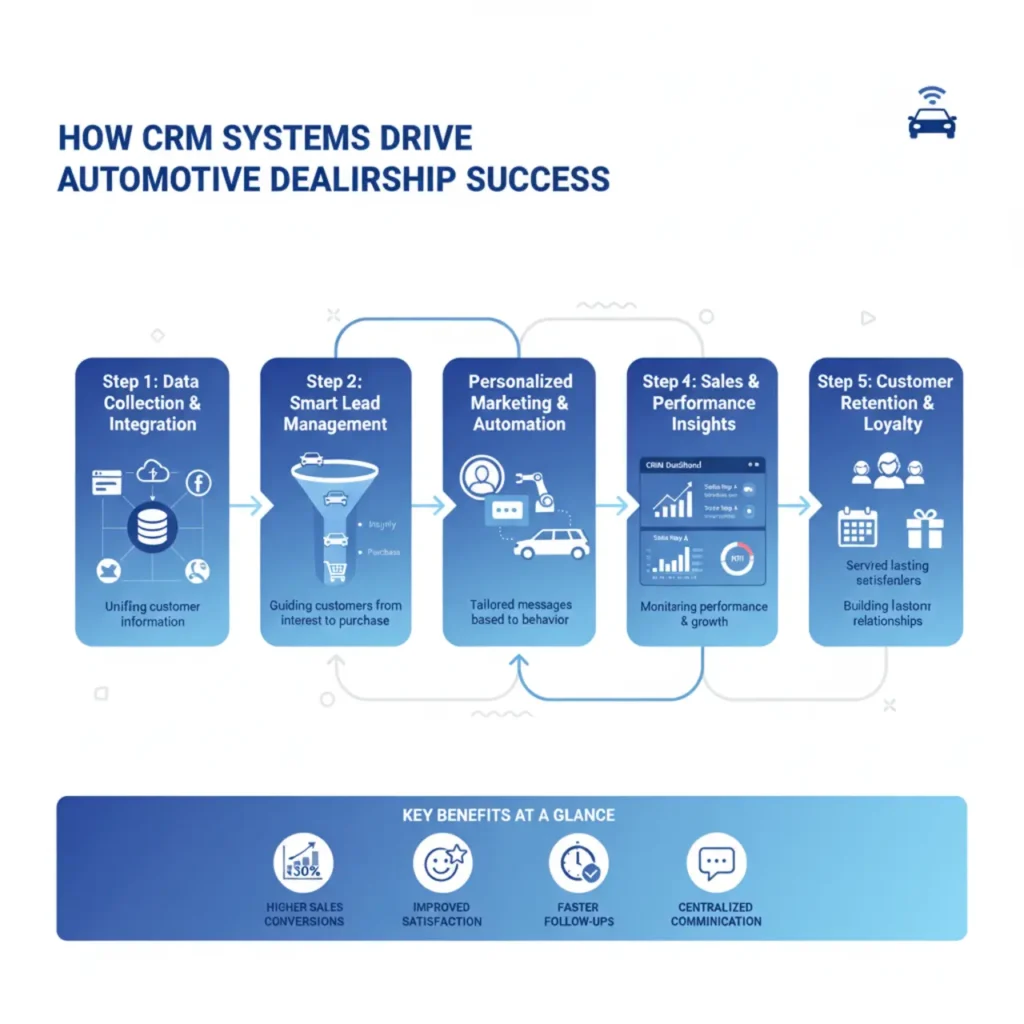
Final Thoughts
In a world where consumer expectations are changing as quickly as technology for vehicles, CRM systems have become the foundation of modern car dealerships. They consolidate operations, equip employees with insights based on data, and ensure that each customer interaction builds trust and loyalty.
Dealerships that are embracing advanced CRM technologies today aren’t only managing relationships, they’re laying the base for continual expansion and success in the marketplace.
FAQs
1. What can a CRM do for a dealership selling cars?
A CRM is a tool to keep track of customer information, streamline communications, track sales opportunities, and enhance service follow-up to ensure that each lead and every interaction with clients is handled efficiently.
2. How can CRM assist lead management?
Through capturing leads from multiple sources in real-time and automating follow-up, CRMs provide speedier response times and greater conversion rates.
3. Can CRM systems help predict customer buying habits?
Yes. Modern CRMs employ predictive analytics to pinpoint the times when customers will most likely buy or trade in their vehicles or service their cars.
4. What are the features dealers should be looking for within a CRM?
Find CRMs that are focused on automotive. They offer lead management and marketing automation, as well as integration with finance and service systems, and mobile access.
5. Which CRM trends are coming up in the auto sector?
Future CRMs will be able to integrate with AI, IoT, and connected vehicle data in order to deliver personalized, real-time experiences for customers.