
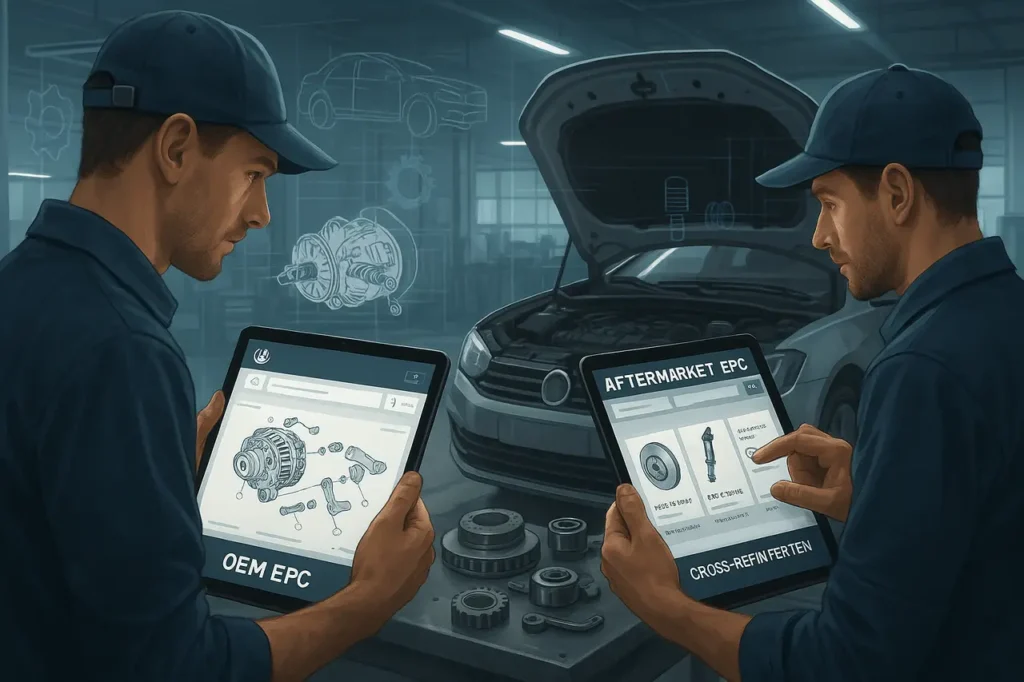
In the ever-changing world of manufacturing, automotive and maintenance of equipment choosing the appropriate EPC Parts Catalog (EPC) solution can determine the success or failure of the efficiency of your operations. In 2025, due to the increasing popularity in electric cars (EVs) as well as AI-driven diagnostics, as well as the complexity of supply chains across the globe, EPCs have become indispensable instruments for identifying parts as well as ordering and inventory management. However, there are many differences between EPCs. EPCs are the same. OEM (Original Equipment Manufacturer) EPCs and Aftermarket EPCs meet distinct requirements, ranging from precise warranty repairs to cost-effective, flexible alternatives.
This thorough guide will explain the Differences Between OEM EPC and Aftermarket EPC solutions, discussing their advantages, features as well as use cases and the future trends. No matter if you’re a dealer manager or an owner of an independent repair shop or an OEM executive, knowing these distinctions can help you select the most suitable solution to minimize downtime, reduce mistakes, and increasing profitability. Let’s take a look.
What is an Electronic Parts Catalog (EPC)?
The Electronic Parts Catalog (EPC) is an online platform that combines spare parts information and allows customers to browse, view and purchase components in a way that is interactive. Contrary to old-fashioned paper manuals or static PDFs, the latest EPCs utilize searchable databases, exploded-view diagrams VIN (Vehicle Identification Number)-based lookups as well as AI improvements to provide rapid, precise results.
EPCs were first introduced in the 1980s, when General Motors launching the first one in 1986. They they have since revolutionized the more than $400 billion global market for aftermarket. They are now integrated with ERP systems as well as eCommerce platforms as well as mobile apps, which support sectors like aerospace, automotive agriculture, and heavy equipment. The main benefits are error reduction (up up to 40% reduction in accuracy of orders) quicker repairs (30 percent time reduction) and real-time updates for combating counterfeit parts.
EPCs fall into two main categories: OEM EPCs, tailored for manufacturer-approved genuine parts, and Aftermarket EPCs, focused on third-party alternatives. The choice depends on your priorities–authenticity versus variety.
What is an OEM EPC?
OEM EPCs are digital catalogs that are licensed or developed by the manufacturers of equipment and vehicles (e.g., Ford, Toyota John Deere) to be used by authorized dealers or service providers. They offer comprehensive, specific to the vehicle data directly from OEM’s engineering sources, which ensures exact matches when it comes to repairs under warranty.
They are delivered via dvd, web-based portals or with specialized software such as Snap-on’s Parts Manager Pro or OEConnection’s OEC EPC, these systems focus on accuracy. Users input the VIN to gain access to exploded 2D/3D diagrams, with hotspots pointing to the part number prices, availability, and. Each month, OEMs provide updates to keep the information up-to-date, and more than 80percent of installations are from specialist companies that scale platforms across brands to increase cost-effectiveness.
OEM EPCs are mandatory by U.S. and Canadian dealers and replace paper catalogs completely and usually incorporate fitment validation and pricing tools.
What is an Aftermarket EPC?
Aftermarket EPCs target independently-owned repair centers, wholesalers and those who are looking for parts that are not genuine from third-party vendors. These catalogs collect information from several brands, providing alternatives like Remanufactured parts, high-performance or even budget-friendly solutions to meet the same repair needs.
Built on industry standards like ACES (Aftermarket Catalog Exchange Standard) from the Auto Care Association, they normalize data for cross-brand compatibility–unlike the siloed OEM systems. Navigation begins with search by make, model and year and results in list of parts compatible with supplier numbers, images as well as optional OEM cross-references. Examples include platforms that offer recycled parts (using the ABPA’s Partslink) as well as eCommerce-integrated catalogues which combine the listings of OEMs and those from aftermarket.
Aftermarket EPCs excel in their flexibility that allows B2B and B2C sales as well as access to mobile devices for technicians on site With less emphasis on exclusive visuals, and more on price comparisons and inventory sync.
Key Differences Between OEM EPC and Aftermarket EPC Solutions
While both simplify parts search, OEM and Aftermarket EPCs differ in their design as well as data and application. Let’s compare them side-by-side:
| Aspect | OEM EPC Solutions | Aftermarket EPC Solutions |
|---|---|---|
| Data Source | Exclusive OEM engineering data Single-brand focus, with real-time updates from the manufacturer. | Third-party suppliers aggregated Multi-brand, standardized via ACES or Partslink to ensure interoperability. |
| Part Options | Only genuine matches There are no other alternatives to protect the integrity of the brand. | Numerous options (e.g., OEM equivalents or upgrades, generics) including pricing and fitting details. |
| Search & Navigation | VIN/model-specific diagrams exploded in 2D/3D with hotspots to build precise models. | Keyword-based, make/model/year, compatibility lists, images and category browsing, but without complete VIN information. |
| Standards & Integration | Automaker mandated; connects to Dealer Management Systems (DMS) along with ERP systems for warranty tracking. | Globally (e.g., ACES) compatible with eCommerce, and synchronizing with shipping APIs and inventory tools. |
| Users & Accessibility | The majority of dealership staff are subscription-based, typically desktop/DVD with mobile accessories. | Access to a wider range of consumers and independents; cost-effective mobile/web-first, offline mode with web/mobile. |
| Update Frequency | Each month, OEM pushes; version-controlled to ensure conformity. | Supplier-driven, real-time using feeds that are standardized However, they are less rigid. |
| Cost Structure | More upfront or subscription (e.g. licensing per dealer) and focuses on the long-term ROI of error reduction. | Lower barriers to entry, Pay-per-use models or freemium models that emphasize large-scale sales. |
| Visual & AI Features | Hotspots with advanced 3D technology, AI Natural Language Search (e.g., “engine bearings for 2023 Ford F-150”). | Basic drawings or images; emergence of AI for visual matching but geared towards efficiency over quality. |
These distinctions stem from their primary objectives: OEM EPCs safeguard authenticity and effectiveness within controlled networks, whereas aftermarket EPCs encourage market diversification and accessibility.
Benefits of OEM EPC Solutions
OEM EPCs perform well in high-risk situations where precision is crucial:
- Error minimization Visual hotspots as well as VIN validation reduces incorrect orders by 40%, and reduce the amount of warranty claims.
- Revenue Protection Real-time pricing and availability help boost genuine parts sales, preventing counterfeits.
- Seamless integration Links between ERP and CRM automate processes, forecasting demand, and streamlining distribution across the globe.
- Compliance and Support Updates that are mandated ensure compliance with the regulations, and include expert-backed user education.
- Scalability Sharing platforms among OEMs can reduce developing costs of 70 – 75 percent according to industry experts.
By 2025 AI advancements such as Intelli Catalog’s MagicPic (auto-enhancing images) will further enhance the benefits to EV repairs.
Benefits of Aftermarket EPC Solutions
Aftermarket EPCs provide access to a wider audience, which is ideal for agile businesses:
- Cost-savings Affordable options can reduce repair costs by 20-50% while not compromising performance.
- Variety and Flexibility Cross-brand options permit rapid sourcing, as well as high-performance enhancements.
- enhanced eCommerce: ACES standardization powers online stores, providing simultaneous OEM/AM comparisons as well as speedier shipping.
- Mobile productivity Offline applications and photo-based search engines cut the amount of time spent in a field by 30 percent..
- Market Expansion Allows B2C sales as well as inventory analytics to help independent businesses stand out from dealers.
As the right-to-repair law evolves and the law changes, these catalogs can provide retailers that aren’t franchised with OEM-like access.
Use Cases and Industries
- Automotive Dealerships OEM EPCs for warranty work; aftermarket to upsell accessories.
- independent Shops EPCs aftermarket for repairs that are budget-friendly on diverse fleets.
- Heavy Equipment (e.g., Construction/Mining): OEM for precision in remote sites; Aftermarket for rapid generics.
- Agriculture It is both to meet seasonal demands–OEM for brand Tractors, and Aftermarket to purchase universal equipment.
- Aerospace and Electric Vehicles OEM for compliance; aftermarket to allow for scalable battery/component sourcing.
Study of a case An U.S. auto dealer using OEC EPC has reported 25percent faster parts lookup as an aftermarket retailer with ACES-integrated tools experienced 35% growth in sales from 2024.
Future Trends in EPC Software (2025)
In the late 2025s, EPCs are AI-centric: Natural language questions (“Show alternators to my hybrid vehicle”) and image recognition using mobile scans are common. Integration with AR/VR to facilitate virtual repairs, blockchain-based part traceability and predictive analytics of inventory are on the rise. Electric vehicles drive demand for modular catalogs that handle software-defined vehicles. Meanwhile, sustainability is pushing eco-friendly part filters. In the near future, expect hybrid OEM/Aftermarket platform that blend authentic and sustainable alternatives with cloud-based scalability prevailing.
Final Thoughts
The differentiator in OEM EPC as well as Aftermarket EPC solutions boils to the nuances of precision and flexibility Select OEM for its uncompromising reliability in dealer networks or Aftermarket for the most cost-effective and flexible options for broad markets. As digital transformation accelerates, investing in a robust EPC–whether standalone or integrated–positions your business for efficiency gains and customer loyalty. Examine providers such as Intelli Catalog or Snap-on based on your needs and also take a look at demos to determine if it is the right fit for you.
Are you ready to upgrade? Check out industry standards such as ACES for seamless implementation.
Frequently Asked Questions (FAQs)
What is the major differentiator that exists between OEM EPC and Aftermarket EPC?
OEM EPCs provide single, manufacturer-approved parts with proprietary data for exact matches, while Aftermarket EPCs offer multiple third-party options using standardized formats like ACES for cross-brand compatibility.
Which is the better choice EPC from Aftermarket or OEM for a dealer?
OEM EPCs are perfect for dealerships that handle guarantees and original parts, providing the highest level of accuracy and seamless integration. EPCs from aftermarket are ideal for independents who require more options and less expensive costs.
Are aftermarket EPC parts as reliable as OEM parts?
The reliability of each supplier varies. Many are in compliance with or surpass OEM specifications, but it is important to check the certifications. Aftermarket EPCs are fitted with information to make sure that they are compatible with.
What is the cost of OEM as compared to. the aftermarket EPC options cost?
OEM subscriptions begin at $500-2,000 per year for each user, with a focus on licensing. Tools for aftermarket are less expensive ($100-500/month) and often come with freemium tiers available for small stores.
Can OEM and aftermarket EPCs work together?
Modern platforms are able to offer hybrid views using standards such as ACES that allow comparisons side-by-side in eCommerce configurations.
What trends will be shaping EPCs by 2025?
AI-driven searches, 3D/AR images and EV-specific applications are crucial, along with the trend towards predictive inventory and real-time syncing across the globe.
Do aftermarket EPCs allow mobile usage?
The majority of offline apps offer photo uploads as well as GPS-linked dealer locators to help on-the-go technicians.