
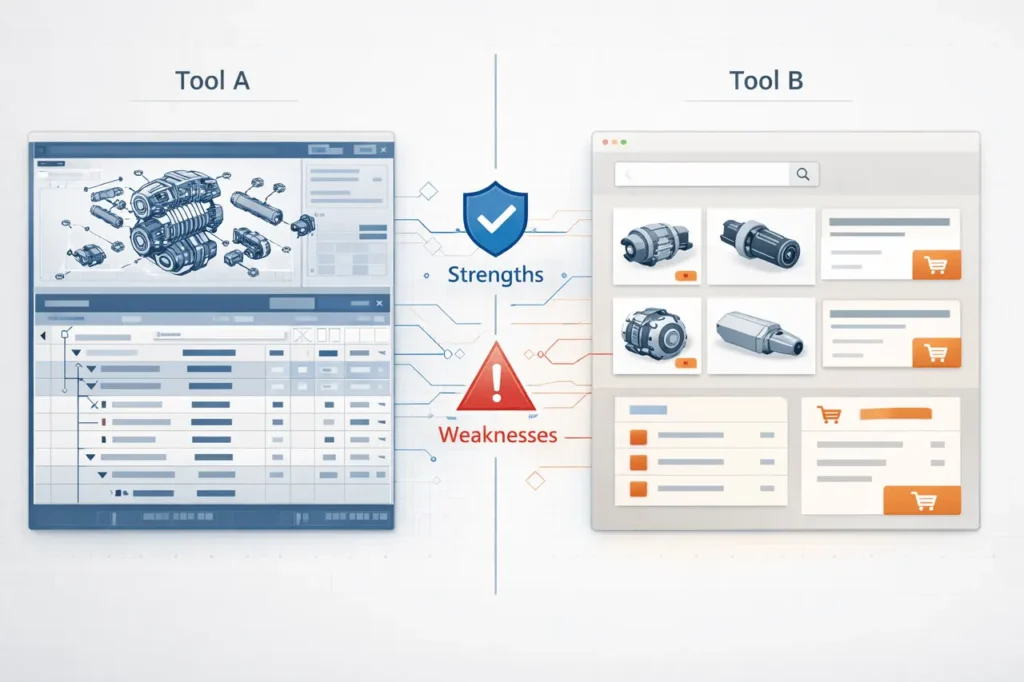
Electronic Parts Catalogues (EPC) constitute the foundation for parts identification, ordering, and after-sales support for distributors, manufacturers, and the service network.
This review compares two archetypal EPC offerings, EPC Tool A (a full-featured, OEM-style platform) and EPC Tool B (a lighter, distributor/aftermarket-focused system). The aim is to help dealers, product managers, and procurement professionals decide on the best compromise between capabilities, cost, and deployment speed.
Quick Overview –
- EPC Tool A: It is Excellent for large and OEM manufacturers who require robust, precise fitment data, engineering change support, detailed visuals and extensive system integrations. Costs are higher, and implementation takes more time.
- EPC Tool B: Suitable for dealers, distributors or companies that require a more straightforward, less expensive implementation with strong search and order flow. There are fewer advanced engineering and visualisation tools, and a lower ERP depth than in the standard ERP.
What is EPC?
The Electronic Parts Catalogue (EPC) is a digital tool used to locate, organise, and manage data on parts, including part numbers, fitment details, and exploded diagrams. It allows dealers, OEMs, and distributors to identify the correct parts for specific vehicles or products swiftly. By reducing manual lookups and improving order accuracy, EPCs play an essential role in after-sales services, inventory management, and parts revenue.
How did I evaluate my tools?
The study uses the standard quantifiable EPC criteria that are common to the industry and in vendor documentation, including catalogue accuracy and update Search and Fitment Intelligence, as well as visual aids (illustrated parts and 3D) and integration into back-end system (ERP inventory), UX for dealers and technicians deployment models, and security and compliance. These are often mentioned as EPC essentials.
1) Data Model & Accuracy
Why is it essential: correct parts identification, supersessions, and compatibility directly impact service accuracy and the amount of revenue.
- Tool A: It is designed to process OEM BOMs, Engineering change orders, BOMs, and OEM fitting tables. It is a strong advocate of authoritative part relationships and structured metadata. Optimal when accuracy is a key factor in guarantee and safety.
- Tool B: Utilises consolidated vendor/distributor information and simplifies fitting logic. Excellent accuracy for aftermarket SKUs; however, it might require additional mapping to accommodate complex OEM supersessions.
Review: If your company relies on the strictest OEM fitment and traceability of engineering changes, Tool A is more secure. However, for large-scale aftermarket sales, Tool B is often sufficient and more affordable.
2) Search, Search and Intelligence
What is it: quick and precise searches reduce the chance of errors in orders and delays in service.
- Tool A: Allows VIN/chassis lookup, intelligent cross-reference and sometimes VIN-to-assembly mapping. Advanced platforms can include AI-assisted search or a guided fitting flow.
- Tool B: focuses on keyword parts, numbers, keywords, and category searches. More efficient for simpler queries, however, it may provide more matches for more complex system or vehicle lookups.
Evaluation: Tool A is a master in matching narrow, high-confidence and Tool B is a speedy alternative and a simple interface.
3) Visuals & Interaction (illustrations, 2D/3D)
What is it: exploded diagrams and hotspots can reduce errors and returns.
- Tool A: Usually provides high-resolution images, such as exploded views, or 3D interactive models linked to the parts (enabling personnel to see inside the assembly). This helps reduce the chance of misplacing orders.
- Tool B: Typically offers annotated images or 2D illustrations and is focused on speedy browsing. Certain providers provide upgraded visualisation software as an upgrade.
Review: If field technicians depend on diagrams, then Tool A offers more of an experience right out of the box.
4) Commerce Flow and Integration
What is it: EPC must be connected to inventory, pricing and order management to function as an effective revenue generator.
- Tool A: Designed for extensive integrated ERP/AFM systems (real-time pricing availability, pricing for dealers, as well as engineering change notifications). Most often, it includes connector toolkits and web services.
- Tool B: Focuses on plug-and-play e-commerce flows and connectors to ERP/POS systems suitable for distributors. They may also require middleware to manage complex ERP landscapes.
Review: For large companies with complicated fulfilment processes, Tool A minimises manual labour; for smaller companies, Tool B minimises the overhead of integration.
5) Cost, Deployment and Time to Return Value
- Tool A: Most often has a higher upfront cost (license data migration, licensing, integration, or configuration) and takes longer to deploy; however, it provides enterprise-level capabilities and less operational friction over the long run.
- Tool B: Low cost and quicker launch; some vendors provide SaaS subscriptions with pre-built data sets for the most common SKUs.
Review: Choose Tool A when ROI is driven by service KPIs, and choose Tool B when speedy commerce integration is a top priority.
6) Security, Compliance and Lifecycle Support
Large companies place great emphasis on data governance, change management, and EOL/RoHS and REACH tracking. These are not negotiable for regulated equipment. Tool A typically has these controls by default; Tool B may require third-party modules.
Electronic Parts Catalogue (EPC): Practical Decision Checklist
- Do you require OEM VIN fitting and traceability of engineering changes? – Tool A.
- Do you think speedy ecommerce/ordering is the highest priority for a wide range of SKUs? – Tool B.
- Are you working with an ERP environment that requires extensive integration? Tool A (unless you’re using middleware-friendly Tools B).
- Do budget and speed-to-market play a role? – Tool B.
Example Pros & Cons (Condensed)
EPC Tool A
- Pros: Advantages: High precision, OEM fitment, advanced visualisations, extensive ERP/engineering integration.
- Cons: Higher cost, longer implementation, heavier data management needs.
EPC Tool B
- Pros: Faster implementation, lower cost, suitable for high-volume aftermarket sales, simpler UX.
- Cons: Poorer OEM changes control less advanced visuals, and could require additional add-ons to ensure compliance.
My Final Thoughts
There’s no single, universal EPC ideal; there’s only the most effective one suited to your specific business needs. The largest OEMs, as well as service firms, must prioritise accuracy, fitment analysis, and Engineering change management (Tool A style). Dealers and distributors that focus on speed, convenience, and cost typically gain greater value from Tool B-style tools. Compare shortlisted vendors against real use cases, such as a VIN lookup, a supersession test, an order flow test, and an integration test, to determine their operational value.
Frequently Asked Questions
1. Does an EPC be used to meet OEM as well as aftermarket requirements?
Certain vendors offer modular EPCs that combine OEM-grade data modules with aftermarket data sets. However, combining data requires careful mapping to avoid conflicts.
2. How important are illustrations when it comes to an EPC?
Very. The explosion of 3D diagrams, as well as the 3D view, decreases errors in orders and returns and improves first-time fix rates. If your business depends on field technicians, prioritise visualisation.
3. Which integrations can I try when evaluating?
Verify inventory availability in real time and pricing for dealers, perform VIN-to-BOM lookups, and submit orders to your ERP or WMS. These are all common issues when they are not verified.
4. Are EPCs from SaaS sufficient for enterprise use?
The most reputable SaaS EPC providers use high-end security and compliance measures and verify the encryption of access controls, audit trails, and the residency of data as part of procurement.
5. How do EPCs deal with changes in engineering?
Enterprise EPCs include engineering change (ECO) workflows that flag supersessions and update pricing/availability. This is a key difference when it comes to OEM-grade tools.
Also Read –