
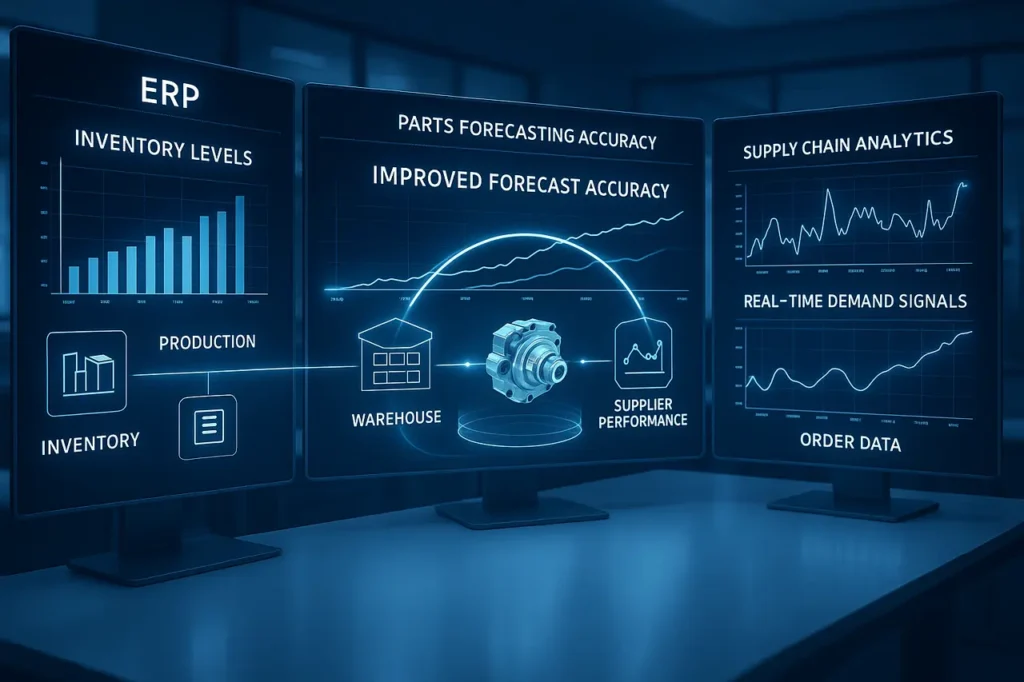
Precise forecasting of spare parts and components is among the engines that quietly run to keep production, field services, and after-sales companies profitable. If forecasts are inaccurate, businesses either stock out, interrupting production and services, or carry over inventory that ties up cash and eventually ages to the point of becoming obsolete. If you implement a well-designed Enterprise Resource Planning (ERP) system that synchronises data across functions, it dramatically improves forecast accuracy.
In this article, we will discuss how ERP data sync works, which features are most important, and how to maximise its benefits.
Why is the synchronisation of ERP data crucial to forecasting the parts of a component?
Parts forecasting is based on a variety of moving parts: historical usage and inventory levels, current stock and open purchase orders’ lead times, bills of material (BOMs), service schedules, and customer commitments. If these data sources reside in different spreadsheets or databases, and forecasts are based on outdated or inconsistent inputs.
An ERP that centralises and synchronises data sources eliminates any guesswork and provides a unified source of information, so demand planners and MRP engines can make their decisions from the same up-to-date database. Centralisation reduces manual reconciliation, reduces the number of decision loops, and increases forecast accuracy.
What ERP data sync enhances forecast accuracy – The Mechanisms
1. Real-time visibility of inventory
If the ERP inventory record is updated regularly (receipts, transfers, returns, and consumption), the forecasting engine can reflect the stock’s actual status. This prevents “phantom inventories” and false safe stock levels, which can distort the decision to reorder. Warehouse management integrated with mobile scans that feed ERP data in real time significantly reduces counting errors and eliminates stale data.
2. Demand signals integrated
Modern ERPs combine demand signals from sales orders, CRM forecasts, sales tickets, and point-of-sale systems to support forecasting. By feeding this information into algorithms for forecasting or MRP, it produces forecasts that reflect anticipated need (sales orders), probable demand (CRM/customer forecasts), and reactive demand (service calls). This mix of inputs reduces unexpected demand and aligns part availability with real-time demand.
3. Complete BOMs and routing information
Parts demand is usually directly derived from the manufacturing of goods or the BOM explosion. If the ERP provides precise BOMs, routings, and substitution rules, it can accurately calculate component demand for production and service tasks. Synchronisation ensures that any changes — engineering modifications, other parts, and so on, are immediately incorporated into forecasts.
4. Automated lead-times, supplier performance and adjustments
Forecasts are only actionable when the supplier’s lead time and reliability are in place for replenishment planning. ERPs that capture supplier lead-time variability, on-time delivery rates, and purchase order statuses can dynamically adjust reorder points and safety stock, reducing stockouts without bloating inventory.
5. Machine learning and analytics are added to the data synchronisation
The synchronisation of ERP data is essential for implementing meaningful analysis and machine learning. Forecasting models (statistical or ML) need clean, consistent historical series and explanatory variables, promotions, seasonality, lead times, and service schedules. If ERP data is synchronised and enhanced, advanced forecasting models can recognise subtle patterns, adapt to irregular or clumpy demand patterns, and provide probabilistic forecasts (not just single-point estimates). Recent industry writing highlights how ERP and AI can significantly increase forecast accuracy when fed high-quality data.
ERP data sync: The Benefits that companies usually see are concrete.
- Reduced Stockouts and Service Disruptions: Accurate forecasts reduce charges for urgent purchases and expedite them.
- Working Capital is Reduced and Linked to Stock: Less safety stock and fewer parts that are no longer in use, resulting in free cash.
- Fewer Planning Cycles and less Manual Work: Fewer reconciliations and plans driven by exceptions allow teams to focus on the strategy.
- Better Collaboration between Suppliers and the Plan: Shared data enables vendor-managed inventory and more real-time delivery commitments.
Priorities of implementation – on which areas to begin?
- Clean and Harmonise Master Information: Start with SKUs, BOMs, units of measure, supplier masters, and lead time. Garbage in = garbage out.
- Incorporate Operational Data Feeds: Connect warehouse WMS Service management, CRM, as well as procurement, to your ERP to reduce silos. Utilise iPaaS or middleware when point-to-point isn’t feasible.
- Allow Real-Time updates to Transactions: Scan-based receiving and consumption events must be posted to the ERP immediately to ensure inventory is up to date.
- Use Layered Forecasting to Incorporate Business and Statistical Inputs: Use automated statistical forecasts to establish a baseline and then overlay customer forecasts and business drivers, all of which are recorded in the ERP.
- Determine the Key Performance Indicators: Track forecast accuracy (MAPE, MASE) and stockouts, as well as supplier turns and OTIF, to ensure the loop closes and continues to improve.
ERP data sync: Common mistakes and How to avoid them?
- Relying on one Method for all Components: Spare parts are usually intermittent. Statistics that are designed for SKUs with high speed are not suitable for slow-moving ones. Utilise segmentation and various rules for spare. Consumable parts vs. manufacturing parts.
- The Controller Data Governance Process is not Being Considered: Without ongoing governance, clean data rapidly degrades. Delegate ownership and automate validations.
- Failure to Close the Loop of Feedback: Track forecast errors and feed them back into the safety supply logic and negotiations with suppliers.
Final Thoughts
ERP data sync isn’t an all-purpose solution; however, it can be the most efficient basis for improving forecast accuracy for parts. Precise master data and real-time transactions interconnected demand signalling, as well as the appropriate analytics built on a synchronised ERP, can help reduce uncertainty, cut costs and enhance the quality of service.
Begin with connectivity and data governance, measure the appropriate KPIs, and iterate as the cumulative benefits become evident in lower stock levels, lower inventory, and more efficient processes.
FAQs
1. What increase in forecast accuracy can I anticipate following SAP data sync?
The results will vary based on the starting place. Organisations that move from siloed spreadsheets to an ERP synchronised invariably see significant improvements, often with two-digit percentage gains in the forecast accuracy of important SKUs and decreases in inventory levels and carrying costs. The exact magnitude of the increase depends on data quality, model sophistication, and the discipline of the process.
2. Can an ERP on its own forecast with accuracy, or do I require additional instruments?
Most ERPs offer basic forecasting and MRP capabilities. For more complex parts profiles (intermittent demand, lengthy lead times), ERP with layered strategies, ERP for master data and transactions, along with specialised tools for forecasting or ML for analytics, typically are more effective. Modern integrations let you use the ERP as your system of record, while also leveraging the most efficient forecasting engines.
3. What is HTML0? How can I deal with low volume and intermittent spare components?
A Segment SKUs based on demand patterns and use custom techniques: simple probabilistic models and service level-driven security stocks for parts that change, and fast-moving parts use forecasting using statistical time-series. Use ERP data to detect patterns and implement segmentation rules.
4. Can the synchronisation impact current operations?
Change management is essential. The stages of rollouts, parallel runs and a strong master data governance reduce disruption. The benefits include fewer emergencies, less rework, and more explicit commitments to suppliers — usually helping offset the transition cost.
5. What KPIs should I track to determine if ERP information sync is functioning?
A: Monitor the accuracy of your forecast (MAPE), Turns of inventory, and stockout days of inventory in hand (DOH), as well as the supplier’s OTIF and percentage of deviations (manual changes following an MRP run). These indicators show whether synchronised data is generating better business decisions.