
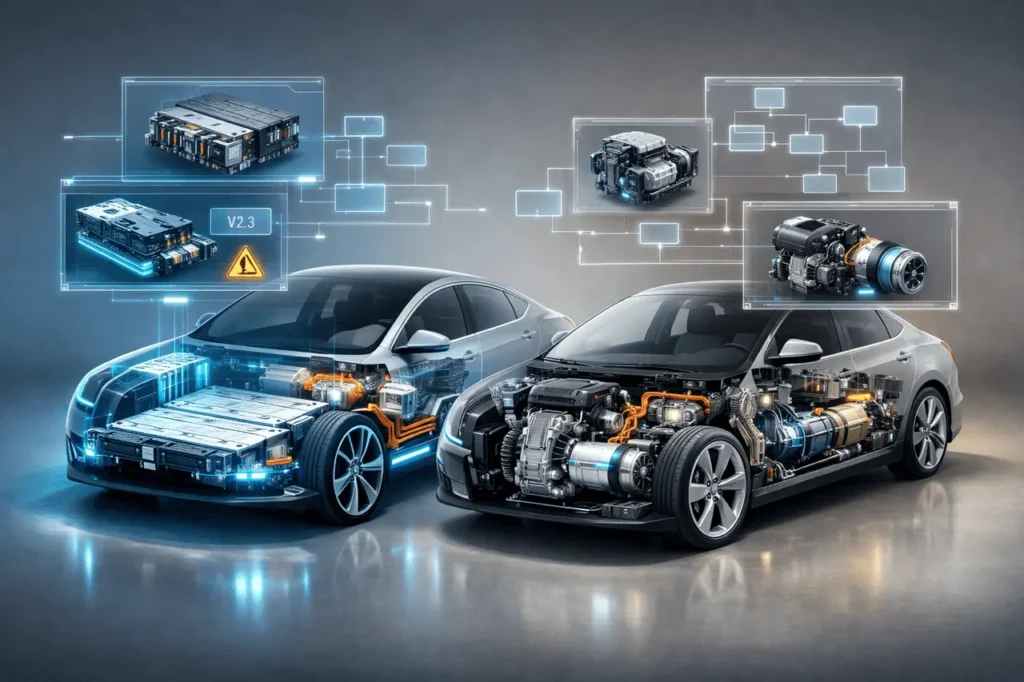
The electric and hybrid vehicle is fundamentally changing the way automotive products are developed, sourced, and maintained, as powertrains shift from mechanical to software-driven systems. This shift changes the EPC (Electric Product Catalogue) from a static inventory of parts to a dynamic, data-driven system.
This article explains EV and Hybrid Vehicles EPC, the meaning of EPC as it relates to hybrid and electric vehicles, what it entails, and how electrification affects EPC requirements throughout the vehicle’s life.
What is EPC for the automotive context?
The Electric Product Catalogue (EPC) is a standardised digital system that organises, stores and makes available specific product information for vehicle components. In the past, EPCs focused on mechanical and consumable components, such as belts, engines, filters, and the exhaust system.
In hybrids and EVs, EPCs expand to include:
- High-voltage electrical components
- Software-dependent assemblies
- Specific configurations for variants
- Safety and compliance metadata
The EPC is a central system for manufacturing, engineering, after-sales, service, and engineering operations.
Why have Hybrid and EV Vehicles’ EPC Requirements Changed?
The hybrid and electric vehicle designs differ greatly from those of Internal combustion engine (ICE) vehicles. These differences directly affect how product data must be organised, updated, and used.
The most important drivers of change include:
- Electric powertrains replace mechanical systems
- Software and rapid model cycles of iteration
- More stringent safety and regulatory standards
- More complex vehicle configuration
In the end, EPCs have to move past static catalogues to become constantly evolving, interoperable data platforms.
The Key Differences between the EV/Hybrid Model and the ICE
| Aspect | ICE Vehicle EPC | EV / Hybrid Vehicle EPC |
|---|---|---|
| Core Components | Engine, transmission, exhaust | Battery pack, inverter, motor, BMS |
| Update Frequency | Low to moderate | High and continuous |
| Software Dependency | Minimal | Critical |
| Variant Complexity | Limited trims | Battery size, motor type, software |
| Safety Metadata | Basic | High-voltage and compliance data |
This transition requires EPCs to oversee the physical and digital definitions of products.
How Hybrid and Electric Vehicles Change the Role of EPC?
1. Expansion of Parts Catalogue to System Catalogue
In EVs and hybrids, numerous components are integrated into systems rather than being independent components. EPCs should be able to represent:
- Battery systems that include cells and modules
- Power electronics that have dependence on firmware
- Thermal management assemblies
There is a requirement for an underlying design model rather than flat lists of parts.
2. Integration of Software and Firmware Information
Unlike ICE vehicles, the performance and functionality of EVs are closely tied to software. EPCs have become increasingly inclusive of:
- Software version compatibility
- Hardware revisions linked to firmware
- Change eligibility metadata
It guarantees that manufacturers and their service teams install the right hardware-software combination.
3. Management of Variant and Configuration
Electric and hybrid vehicles usually contain more configuration options than ICE models, such as:
- Capacity options for batteries
- Motor configurations (single vs dual)
- Standard for Charging and Regions
EPCs should automatically filter products based on vehicle identification information rather than rely on manually selected products.
4. Safety as well as Regulatory Data Embedded into EPC
High-voltage systems bring new security and compliance requirements. Modern EPCs can store and display:
- Voltage class indicators
- Isolation and handling needs
- Regional-specific conformity attributes
This information is a safety feature that enables more secure servicing and regulatory compliance.
5. Lifecycle Coverage beyond Aftermarket Use
For hybrids and electric vehicles, EPCs are becoming more popular across the entire vehicle lifecycle:
- Engineering change validation
- Manufacturing bill-of-materials alignment
- Operations for service and warranty
- Recycling and battery replacement workflows
The EPC is now an open source of truth, not an auxiliary reference tool.
EPC Application Cases within EV as well as Hybrid Ecosystems
| Function | EPC Role in EV / Hybrid Vehicles |
|---|---|
| Engineering | Validate component compatibility |
| Manufacturing | Align variants and configurations |
| Aftersales | Ensure correct high-voltage parts |
| Service | Reduce diagnostic and installation errors |
| Compliance | Track safety and regulatory attributes |
These cases demonstrate EPC’s increasing strategic importance.
Benefits of having an EV-Ready EPC
Adapting EPCs for electrified vehicles delivers tangible operational advantages:
- Reduced the mismatch of parts and service error
- Rapider adoption of design modifications
- Increased safety conformance
- Better customer service accuracy
- More robust integration with digital automotive platforms
As the adoption of EVs increases, EPC quality directly affects the effectiveness of risk management and efficiency.
EV and Hybrid Vehicles EPC: Limitations and challenges
Despite its importance, EPC Modernisation for electric vehicles and hybrids is not without its challenges:
- Legacy EPC systems lack data flexibility
- High data maintenance overhead
- A complex integration of PLM and a tool for service
- Continuous updates are triggered through software updates
Companies must address these issues to maximise EPC value.
Practical Ideas for Business
To ensure that EPCs with hybrid and electric vehicle specifications, organisations should concentrate on:
- Modular product data structures
- Real-time update capabilities
- Solid integration service and engineering systems
- Easy handling of software and hardware dependencies
EPC conversion is equally an issue of data governance as it is a technical issue.
My Final Thoughts
Electric and hybrid vehicles completely redefine the EPC’s function. The EPC, which was previously an inactive Electric Product Catalogue, is now a dynamic, system-level platform for electrified powertrains that can support software-driven components and intricate configurations.
As vehicle designs continue to evolve, EPCs will remain essential to ensure safety, accuracy, and operational efficiency. Companies that adapt their EPC strategies now will be better equipped to meet the realities of hybrid and electric mobility.
FAQs
1. What is the impact of EVs on the traditional EPC systems?
EVs bring electric systems, software dependencies, and more frequent updates that traditional EPCs weren’t designed to handle.
2. Are EPCs still important in hybrid cars?
Yes. Hybrid vehicles combine ICEs with electric components, making EPCs essential for managing mixed components and their architectures.
3. Do EPCs contain software in the EVs?
Modern EPCs are increasingly equipped with software compatibility and firmware metadata linked to physically based components.
4. Why do safety data have more importance when it comes to EV EPCs?
High-voltage components require rigorous handling procedures, as well as conformity and isolation regulations clearly stated within EPCs.
5. Are EPCs only used to provide aftermarket services?
No. In hybrid and EV ecologies, EPCs support manufacturing, engineering, and other processes that are nearing the end of their lifespans.
Also Read –
EPC Trends in 2026: Key Changes, Technologies and Outlook
AI-powered EPC Search: A Smarter Way to Find Electronic Parts