
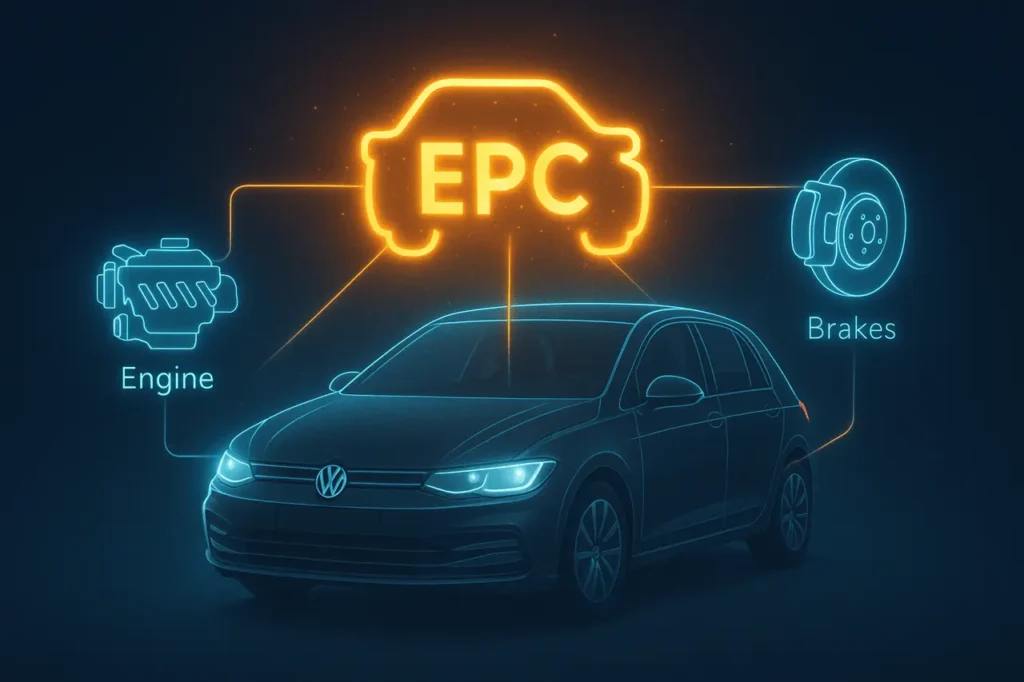
If you are the owner of a Volkswagen and then suddenly notice an EPC indicator shining on your car’s dashboard, then you’re certainly not the only one. It’s the EPC light, which is short for Electronic Power Control, and is an unusual warning signal for VW models like Jetta, Passat, Golf, and Jetta. It is usually a sign of an issue with the electronic control system in the vehicle, which is a network that controls the throttle, engine, and many other essential functions.
In this thorough guide, you’ll be taught how to fix this EPC light on Volkswagen vehicles, what the cause is, what you can do to stop it, and when it’s the right time to take your vehicle to the mechanic.
What Does the EPC Light Mean?
The EPC light is a part of a vehicle’s diagnostic system onboard. It is a sign of an issue with one or more electronic components that control the performance of the engine. Contrary to other warning lights that are directly related to mechanical problems, the EPC light is related explicitly to electronic controls in the vehicle.
If the EPC light turns on, it typically indicates the presence of a problem with some of the systems listed below:
- A throttle control system that includes an electronic throttle control as well as a sensor for throttle location.
- Brake system – Issues related to ABS sensor or circuits for brake lights.
- Sensors for the engine management system, like crankshaft or camshaft sensors that measure position, may be damaged.
- The transmission system of modern vehicles utilizes electronic signals to control the shifting of gears.
The flashing of this light is a signal to be aware that driving with an EPC light on can cause additional transmission or engine problems if you do not pay attention.
What Is the EPC Light on VW?
The EPC lamp can be found in Volkswagen’s engine control system. When it’s lit, it signifies that the electric power control unit detects a problem. The system controls the throttle body as well as cruise control, brake sensors, and various other engine components.
Although the EPC light may look like an engine check light, it’s specifically pertaining to electronics instead of general engine problems.
If the EPC light comes on, the car’s computer can be in limp mode — a security feature that reduces power to shield the transmission and engine from any further damage.
The symptoms that are associated with EPC Light
The EPC light could be accompanied by other signs that include:
- Power reduction or activation of the limp mode
- Stalling or rough idle
- Hesitation during acceleration
- The throttle pedal does not respond.
- Problems with transmission shifting
It is crucial to remember that the exact symptoms may differ depending on the reason and the model of the vehicle.
Common Causes of the EPC Light on Volkswagen
Many factors can trigger the EPC light on VW vehicles. Knowing the causes will aid in identifying and fixing the issue quickly.
1. Faulty Throttle Body
The body of the throttle controls the air that enters the engine. Carbon deposits that build up or a damaged throttle actuator can result in erratic idle, or loss of power, and cause the EPC warning.
2. Malfunctioning Brake Light Switch
Volkswagens depend on brake light switches to provide both braking and engine control communication. A damaged switch can be a source of confusion for the ECU, which could result in the EPC light being turned on.
3. Accelerator Pedal Sensor Failure
Modern VW cars have an electric accelerator pedal that is not a traditional cable. When the sensor for pedals fails, then the ECU isn’t able to correctly read the signals for acceleration.
4. Wiring or Sensor Issues
Frayed wiring, loose connections, or malfunctioning sensors (like the crankshaft’s location as well as the MAF sensor) could disrupt communication between control modules and cause an EPC warning.
5. Engine Misfire or Ignition Problem
Problems such as bad spark plugs or ignition coils, or fuel injectors, could result in misfires that can cause the EPC or check engine light to appear at the same time.
6. Software or ECU Malfunction
Sometimes, obsolete ECU software, or even a short-term communication issue, can cause the light to flash. In such instances it is possible to fix the issue with a software update or system reset could solve the issue.
How to Fix EPC Light on VW (Step-by-Step)
The fix for fixing the EPC light on the Volkswagen is dependent on the root issue. Here’s a step-by-step guide to fix the problem:
Step 1: Perform a Diagnostic Scan
Utilize the OBD II scanner and/or visit an auto mechanic for a check for errors stored within the ECU.
Common VW EPC error codes are:
- P0221: Throttle/Pedal Position Sensor
- P0507 The Idle Control System’s RPM is higher than anticipated
- P0562: System Voltage Low
The codes can help identify the cause of the issue without the need for unnecessary replacements.
Step 2: Inspect and Clean the Throttle Body
If your scan reveals issues with the throttle:
- Get rid of the throttle’s body.
- Clean it with the throttle cleaner as well as the use of a gentle brush.
- Reinstall and set the throttle adjustment by using a diagnostic tool, or by turning off the ignition (without beginning) after 30 seconds.
Step 3: Check Brake Light Switch
An easy yet widespread reason for VW automobiles.
- Use the brake pedal, and if the brake lights aren’t lit, change the switch (usually situated just above the pedal).
- This repair is not expensive and usually fixes the EPC problem immediately.
Step 4: Examine Accelerator Pedal Sensor
If acceleration seems sluggish or uneven:
- Examine the pedal connector for corrosion or dirt.
- If required, it is necessary to change your pedal sensor assembly.
Step 5: Test Battery and Alternator
Incorrect or low voltage delivery could confuse electronic modules.
- Make use of a multimeter to ensure that the battery’s output is at a minimum of 12.6V on the off side and 13.7-14.7V when it is running.
- Change or charge if the values are not in line.
Step 6: Reset the EPC Light
After solving the problem, you can restore the EPC light using two methods:
- Make use of the OBD II tool to erase codes.
- The battery should be disconnected and let it sit for fifteen minutes (temporary reset, light may be restored if the issue persists).
When to Visit a Mechanic
In the event that your EPC light is still on even after the basic troubleshooting process, you should get a certified VW mechanic to check the vehicle.
Get immediate assistance for:
- The car goes into “limp” mode and will not accelerate correctly.
- The EPC light is visible alongside an ABS light. Check the Engine as well as the ABS lights.
- There is a lot of rough idle, frequent stalling, and energy loss.
Professional diagnostics can consist of testing the ECU, replacing sensors, or updating the software in your vehicle.
Repair Options and Estimated Costs
Repairs are based on the cause. However, expect to pay between $100 and $500 for diagnostics and small repairs such as cleaning the throttle. Replacement of sensors (e.g., MAF for 150-300) and pedals ($200-400) is in the middle. More serious issues, such as ECU flashing or wire repair, could cost between $800 and $1,500.
VW dealerships utilize genuine parts for durability, which is often covered by warranty for newer models. Independent shops that have VW know-how save between 20 and 30 percent; however, they must verify that the certifications are valid. Vehicles manufactured after 2010 may be eligible for extended warranties for problems like throttle bodies.
How to Prevent EPC Light Issues in VW
The practice of preventive maintenance can go far in the prevention of the possibility of EPC issues.
- Regular maintenance: Follow Volkswagen’s recommended maintenance schedules.
- Clean components of the throttle: Prevent carbon buildup by sweeping every 10,000-15,000 km.
- Monitor sensors frequently: Especially brake and accelerator sensors.
- Use a quality fuel: A poor fuel quality can impact the combustion process or sensor measurements.
- Beware of overloading your electrical system: Don’t install aftermarket devices that draw power in a way that is not compatible with the ECU system.
Troubleshooting Table: Quick Reference
| Symptom | Likely Cause | Suggested Fix |
|---|---|---|
| EPC light + limp mode | Faulty throttle body | Clean or replace throttle body |
| EPC light + brake warning | Brake switch failure | Replace brake light switch |
| EPC + Check Engine Light | Faulty sensor (MAF, crankshaft) | Diagnose and replace sensor |
| EPC after battery change | Voltage drop or ECU error | Reset ECU / check connections |
| EPC light + rough idle | Air leak or throttle issue | Inspect air intake and gaskets |
Are you able to drive using an EPC Lighting On?
Driving using an EPC indicator is not advised, particularly if the car is in limp mode or has decreased engine performance. Although minor issues might not cause immediate harm to the vehicle, not heeding the warning could lead to:
- Engine damage
- Transmission failure
- The safety risks of driving
It is advisable to stop and get a professional inspection in the event that the EPC light is illuminated when driving.
EPC Light vs Check Engine Light
It’s crucial to distinguish between those who have the LED for the EPC in contrast to that of the Check Engine Light (CEL):
- EPC Light: Specifically relates to electronic engine control and throttle control issues. Most often, it is used on European cars such as VW or Audi.
- Check Engine Light: An additional warning that indicates any issue with the engine that could be minor, such as a loose gas cap, or more serious engine malfunctions.
In rare instances, the lights could be illuminated simultaneously, indicating an urgent problem that needs immediate attention.
FInal Thoughts
The EPC indicator appearing on Volkswagen cars can be a sure indication that something is wrong with the power control system’s electronic components. Although it could be something as simple as a defective brake switch or unclean throttle body, neglecting it can lead to serious transmission or engine issues.
Being aware of how to repair the EPC warning light on your VW lets you take action swiftly, whether you decide to fix it on your own or take it to a professional mechanic. Maintenance and regular diagnosis are the best protection against frequent EPC warnings, making sure your VW performs well for many years into the future.
FAQs: EPC Light on VW
What does the EPC light refer to on the dashboard of a VW automobile?
This means that the Electronic Power Control system has identified a problem in your vehicle’s brakes, throttle, or engine control system.
Am I able to drive while an EPC lamp is on?
It’s not advised. The vehicle could go into weak mode or cease to function. It is recommended to drive with care to a repair shop.
What can I do to reset my EPC indicator on the Volkswagen?
It is possible to employ a diagnostic scanner or shut off your battery from it for a short period of time; however, this will only remove the light temporarily until the problem is rectified.
How much will it cost to replace your EPC light on the VW?
The cost varies based on the issue: cleaning the throttle body ($100-$250), the replacement of brake switches ($50-$100), or the repair of the sensor ($150-$400).
Why does my EPC light come back on?
The persistent EPC lights suggest an unresolved problem, usually related to wiring, sensors, or a throttle body issue.