
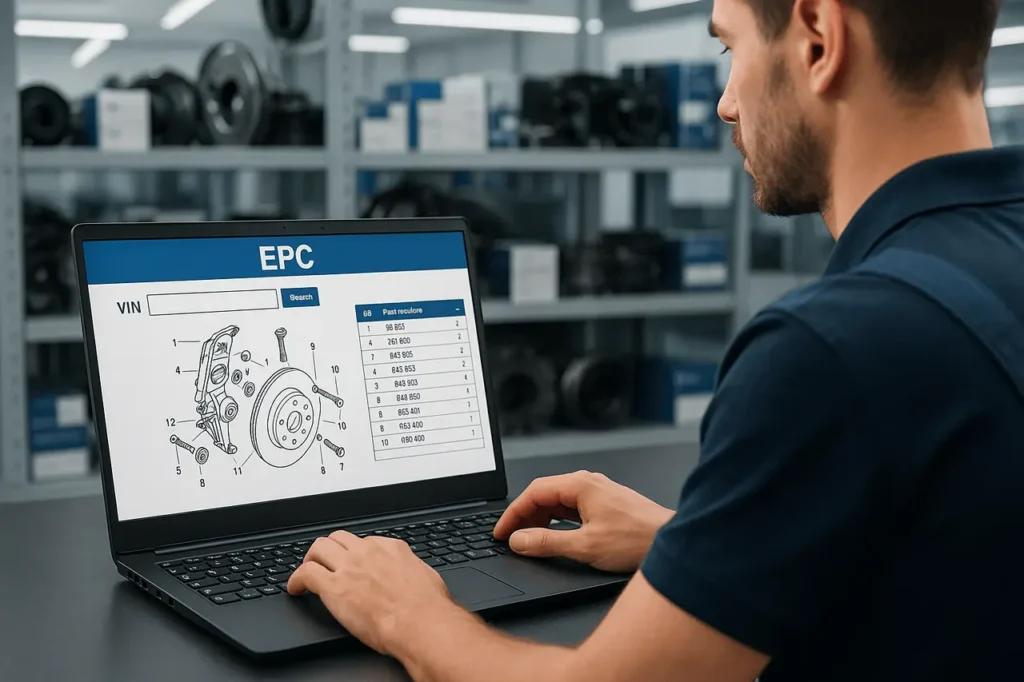
In today’s fast-paced world of auto repair, manufacturing, production, and maintenance of equipment, finding the correct part quickly and precisely could make all the difference. Take a look at the Electronic Parts Catalogue (EPC) system. It’s a digital powerhouse that makes the process of searching for the right parts, components, and assemblies. It doesn’t matter if you’re a dealer technician, a fleet manager, or an amateur DIYer; knowing how to use the EPC system can save time, minimise errors and guarantee compatibility.
This detailed guide will take you through how to search for a part in an EPC system step-by-step, utilising the most common EPC platforms, such as those employed in Toyota, Mercedes-Benz, and special software such as Intelli Catalogue.
In the end, you’ll be able to navigate any EPC confidently, as well as the answers to the most frequently asked questions.
What is an EPC System and Why Does It Matter?
An EPC system is an online database or software-based system that stores parts for cars, machines, industrial, or other equipment. It replaces heavy manuals on paper by incorporating interactive tools, such as illustrations that explode, VIN lookups, and a search for part numbers. These tools are crucial in fields like automotive, where one incorrectly matched component can result in expensive rework or safety concerns.
Benefits include:
- Precision: The visual tools and filtering stop placing the wrong component (e.g. left-hand components vs. Right-hand components).
- Efficiency: Searches that used to take hours can now be completed in a matter of minutes.
- Integration: Integration with HTML0: A lot of EPCs connect to pricing, inventory and ordering platforms for seamless workflows.
With the growing demands for authentic OEM parts – projected to increase by 5percent per year until 2030, knowing how to utilise the EPC isn’t just a matter of skill but also a competitive advantage. Now, let’s take a look at the steps.
How to Search for a Part in an EPC System: Step by Step
Use these guidelines to identify the exact component you require:
Step 1: Access the EPC System
The basis of any successful search begins with the process of gaining access. The majority of EPC platforms require a valid ID, particularly for use by professionals.
- For Professional or Dealership Access: For Professional Access or Dealership: Sign in through your company’s portal. For example, Toyota’s EPC is available at toyota-usa.epc-data.com, while Mercedes-Benz users access it through StarTec or similar dealer software. Log in with your user name, password, and any two-factor authentication codes.
- For Consumer or Public Access: Certain companies offer search engines that use VINs for free, like Lotus’s web-based EPC located at lotusparts.com. Visit the website of the manufacturer and navigate through the “Parts” section, and choose “Electronic Catalogue” or “Parts Lookup.”
- Mobile Applications: Download apps such as Intelli Catalogue for Android or iOS and allow offline access to cached searches. Check that your device is compatible (e.g., iOS 13+).
Pro Tips: Save the login page, and then enable auto-fill to make it easier for you to access the Site in the future. If you’re not familiar, search for tutorials. Most systems come with the “Help” or “Demo” mode.
Step 2: Enter Vehicle Identification Details
EPCs are specific to the vehicle in order to prevent inconsistencies. This process narrows the range of components that are compatible.
- Use VIN Lookup (Recommended): The Vehicle Identification Number (VIN) can be described as a unique 17-digit number that is specific to your vehicle. On your dashboard, door jamb, or title, it records the year, make, model and the specifications.
- Look for the search bar located on the dashboard.
- Enter the full VIN and then click “Validate” or “Search.”
- The system interprets it, giving the summary (e.g., “2023 Toyota Tundra, SR5 Trim, 4WD”).
- Alternative: Manual Selection: If VIN isn’t in your pocket, select from the dropdowns below:
- Select Year (e.g., 2025).
- Pick Make/Model (e.g., Lotus Emira).
- Specify Trim, Driveline (FWD/RWD), and Engine Type.
This produces a customised catalogue, removing irrelevant choices. Toyota’s system, for example, VIN entry auto-populates cab type and drivetrain.
Common Deficiency: Check the VIN twice, as typos could result in zero results. If you encounter issues, try the “VIN Decoder” tool if it is available.
Step 3: Navigate to the Relevant Section
When the car is filled, go through the categories until you are able to narrow in on the topic of interest.
- Category Selection :
- In the menu at the top, select a tree or grid composed of segments: Engine Brakes, Suspension, Body and Interior.
- Click on the desired item (e.g., “Cooling System” for a hose for a radiator).
- Assembly Breakdown :
- Sub-menus can be expanded into assemblies (e.g. under Engine Head, Cylinder Head, Timing Belt).
- Choose one to display an inventory of similar parts.
Within Lotus EPC, this appears as a grid post-vehicle select and in Intelli Catalogue, it’s a top-down navigation using search filters.
Efficiency Hack: Use the breadcrumb trail at the top of the page to go back without having to restart.
Step 4: Use Visual Diagrams for Identification
EPCs are dazzling with interactive exploded views – digital diagrams that show how components can be put together.
- Loading the Diagram :
- Click an assembly for the 2D or 3D diagram.
- Letters or numbers identify elements (e.g., “1” for bolt, “15” for gasket).
- Engaging in the view :
- When you hover or tap on parts, they illuminate or glow to provide interactivity.
- Zoom out (pinch on a mobile) and rotate models in 3D.
- Click a part with a label to jump to its information.
For instance, Toyota’s EPC displays the schematics and is accompanied by “View Full Size” options; Mercedes guides emphasise selecting subgroups to get precise drawings.
Visual Tip: Take note of footnotes to note variants (e.g., “RH” for right-hand side) and amounts (e.g., “(2 req’d )”).
Step 5: Identify and Select the Part
Find exactly where you are.
- From the Parts List :
- In the area below, look at the table. Columns contain Ref # Description, Part # Quantity.
- Find the diagram’s label and match it to the row on the list.
- Click on the blue highlighted part number to open a window with pictures as well as specifications and fitting notes.
- Verification :
- Make sure to check “What This Fits” for cross-compatibility.
- Review the inventory status (in-stock or backorder).
- Note supersessions — EPCs flag obsolete components and replace them with new ones.
For advanced systems, such as Intelli Notes or quantities directly here before carting.
Step 6: Obtain the Part Number and Proceed
The objective is to secure an alphanumeric number (e.g. 90901-12345) for placing an order.
- Extract Details :
- Find the Part Number from the information page.
- Be aware of all suffixes (e.g. colour codes such as “MD GRAY”).
- Next Actions :
- Add cart to cart to order internal items.
- Convert the list to PDF, or send the list to.
- Cross-reference with other sites such as autoparts.toyota.com for prices.
To meet your bulk requirements, save favourites to ensure repeated access.
Benefits of Using an EPC System
- Accuracy: Avoids ordering incorrect parts.
- Fast: VIN filters and diagrams simplify the search.
- Transparency: Gives specifics on pricing, replacements, and quantities.
- Integration: Integrates seamlessly into the databases of suppliers.
- Professionalism: Establishes trust by exact parts management.
Through mastering how to utilise the EPC system workshop, dealerships can drastically reduce mistakes and increase the speed of service delivery.
Advanced Search Options to Supercharge Your Workflow
Beyond the basics, EPCs offer power-user features:
- Part Number Search: Search for a well-known number (e.g., “12345-67890”) to get immediate results. Ideal for Reorders.
- Keyword Search or Text-Based: Keyword Search: Enter “brake pad” to filter across different categories. Use quotes for exact phrases (“front left calliper”).
- AI as well as Visual Tools: Visual Tools and HTML0: In modern EPCs, such as Intelli, users can ask questions naturally (“bearings in the Velocity LXI engine”) or upload images for recognition.
- Filters Sort by price, availability or manufacturer. Terms that are negative (e.g. aftermarket, -retail) to only OEM.
This reduces the time to search by 70% as per benchmarks for the industry.
Common Challenges and Solutions
- Doesn’t work?: Verify VIN accuracy or attempt to manually enter. Clear the cache if you are on the web.
- Do you feel overwhelmed by options?: Use filters and diagrams to reduce the options.
- Superseded parts?: Always check the history icon in order to avoid cancellations.
- Mobile Glitches?: Switch to offline mode or desktop to get more complex views.
Regular updates keep EPCs current–check for software patches quarterly.
Final Thoughts
Understanding how to find parts in EPC systems can help you find a part. The EPC system allows you to manage maintenance, repairs, and inventory with a high degree of precision. From VIN-based search for parts to gaining an understanding of the latest updates to OEM part numbers, EPC systems simplify the entire process of auto parts management.
Following the steps described in this article, it is easy to determine, confirm and purchase the right parts, reducing time and money and ensuring a perfect fit each time.
FAQs: How to Search for a Part in an EPC System
1. What if I don’t possess the VIN for my car?
The manual selection of model, year, make and trim is well. The majority of EPCs have a “Build My Vehicle” wizard to guide you through.
2. Can I utilise my EPC device offline?
Yes, mobile apps such as those of Intelli allow offline cache for parts that are viewed. Connect to the internet when you’re back to update.
3. How can I tell whether a component is obsolete?
Find a symbol for change or a history tab beside the number of parts. It will show the replacement as well as the date of effectiveness.
4. Are EPC searches available for consumers at no cost?
Numerous manufacturer websites provide free VIN checkups; however, full access could require a login from a dealer. Third-party software can vary in price.
5. What is the distinction between 2D diagrams and 3D ones in EPC?
2D schematics are flat and provide quick viewing; 3D allows rotation for better spatial comprehension of assemblies.
6. How precise is the accuracy of AI search results for EPC systems?
Highly precise for descriptive queries, but always confirm using diagrams to spot subtleties like specific parts for the side.
7. Are EPCs integrated with order platforms?
There are many ways to connect directly to carts for dealers’ ERP systems, dealer carts or websites such as RockAuto to make purchases with one click.