
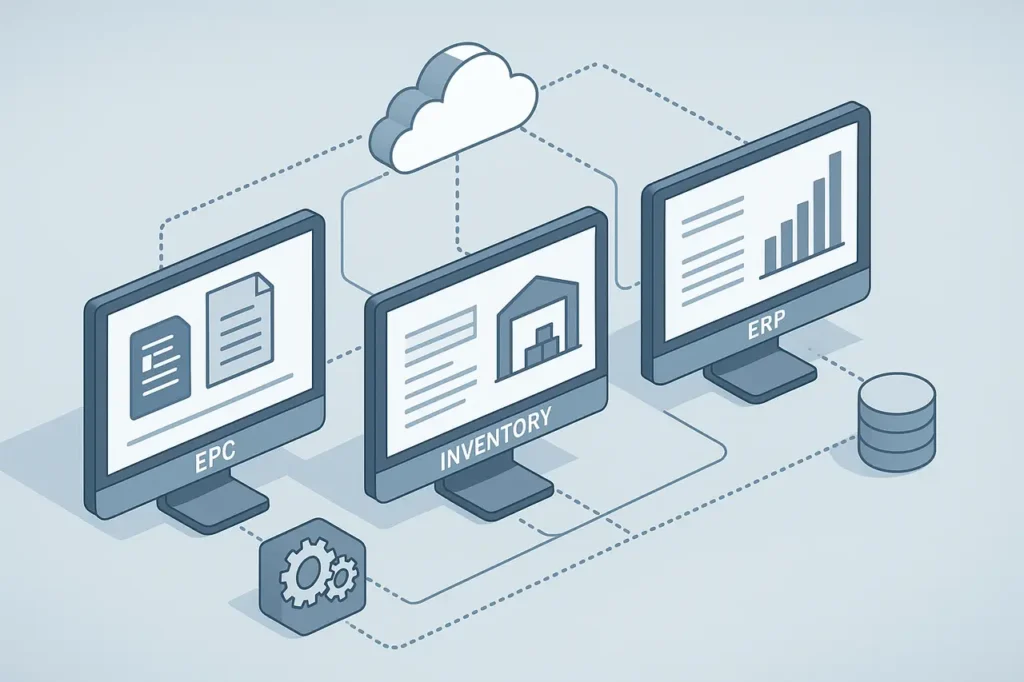
In today’s digital world, manufacturers, dealers, and service providers rely on precise parts information to guarantee efficient operation. It is no surprise that the Electronic Parts Catalogue (EPC) is now a crucial instrument in various industries like agriculture, automotive, heavy machinery, and manufacturing. To fully realise the potential of this tool, linking EPC with ERP and Inventory (Enterprise Resource Planning) systems is crucial.
The integration doesn’t just improve the flow of data, but also increases efficiency in operations, minimises mistakes made by hand, and increases customer satisfaction. In this article, we’ll look at the main advantages, strategies for implementation, and pitfalls of the integration of EPC together with Inventory and ERP systems.
What Is an EPC (Electronic Parts Catalog)?
An Electronic Parts Catalogue (EPC) is a database in digital format which provides complete information on components, assemblies and machinery components or vehicles. EPC systems permit dealers, technicians and distributors to:
- Make sure you can identify parts with precision with diagrams and exploded views.
- Make sure that the item is compatible and has the correct fitment specifications.
- Get up-to-date pricing and product information.
- It is easier to streamline parts ordering and replacement procedures.
An EPC can eliminate the inefficiency of printed catalogues through instant updates and interactive access to data about products.
What is the reason to integrate EPC in Inventory as well as ERP Systems?
While an EPC aids users in identifying the right components, it is truly effective when integrated with the Inventory Management or ERP platforms. The reasons for integration are:
1. Real-Time Data Synchronisation
If your EPC integrates into ERP as well as inventory software, the entire inventory, product and pricing information is constantly updated. This ensures that users always see the latest information–eliminating mismatched part numbers, outdated prices, or unavailable stock.
2. Faster Order Processing
Dealers and technicians can easily examine stock levels and place orders through the EPC interface. Its integrated ERP system creates invoices, purchase orders and stock updates, thereby reducing manual labour and speeding the fulfilment process.
3. Improved Customer Experience
Customers expect fast, accurate service. Integration means that service and sales teams are able to offer rapid answers on availability of parts, availability, and delivery times, which results in greater levels of satisfaction and loyalty.
4. Error Reduction and Cost Savings
Manual entry of data between different systems is often prone to error. Integration can automate this process by limiting human intervention and reducing the chance of mistakes in order entry and, ultimately, saving operational expenses.
5. Better Analytics and Decision-Making
With data synchronised across EPC inventory, EPC, and ERP software, executives are able to create extensive reports–covering trends in sales, parts performance, and forecasting of demand. This enables more innovative production and procurement planning.
How EPC Integration Works
The integration process links the EPC database to the ERP system data. ERP software’s master information like parts numbers, product IDs, stock levels, prices and supplier details. The way it works is as follows:
- Data Mapping and Synchronisation: The EPC draws relevant information about parts from ERP, including SKUs, pricing, and availability. Any changes made to the ERP are automatically updated to the EPC.
- API or Middleware Connection: Integration is typically achieved through APIs (Application Programming Interfaces) or middleware software that functions to act as bridges between the systems.
- Real-Time Order Management: When a component is chosen and ordered through EPC, the details of the order are passed directly to an ERP. The ERP handles it, adjusts the stock levels and sends the status back to EPC.
- Inventory Control and Notifications: The integrated systems will send out automatic notifications whenever stock levels fall below thresholds, which allows for proactive replenishment.
- User Interface Integration: The EPC front-end remains a breeze for users, while backend synchronisation is seamless thanks to ERP connectivity.
Benefits of EPC and ERP Integration
Integration of EPC together with ERP systems offers a wide variety of benefits:
1. Seamless Workflows
Sales staff, technicians and warehouse teams function in a unified platform. There is no need to switch between platforms, as every function is integrated and controlled.
2. Enhanced Productivity
Faster processing of orders, automatic updates to stock, and fewer manual interventions allow companies to reduce time and increase efficiency.
3. Accurate Inventory Visibility
Integration makes sure that the EPC shows the current levels of inventory and helps stop backorders and excessive stocking.
4. Stronger Supplier and Dealer Relationships
Suppliers are able to receive orders on time, and dealers can gain access to exact parts information as well as order trackers, enhancing overall coordination.
5. Data Consistency Across Departments
All departments, from logistics to sales, rely on the same database source for all their data, which helps reduce discrepancies as well as ensure the accuracy of the data.
Implementation Best Practices
1. Assess System Compatibility
Before integration, determine if you are currently using ERP as well as EPC platforms that can support Integration using APIs and if you require middleware software.
2. Data Cleansing
Make sure your inventory and product information are up-to-date and consistent. Part numbers that are inconsistent or out-of-date product information can lead to problems with integration.
3. Choose the Right Integration Partner
Choose a provider of technology or a consultant who has experience with EPC-ERP integration. This is especially important in your field (e.g. automotive and machinery).
4. Pilot and Test
Test integration during an initial trial phase to discover any problems before a full-scale rollout. Testing is a way to ensure reliability and data integrity.
5. Train Your Team
Training for users to use the new integrated interface and comprehend the connection between EPC and ERP systems.
Common Challenges in EPC-ERP Integration
Despite their advantages, companies are often faced with several problems:
- Legacy Systems: Older ERP software may lack integration capabilities.
- Data Silos: Disconnected systems can cause inconsistent or duplicate data.
- Requirements for Customisation: Every business could require specific workflows for integration.
- Limitations on Time and Cost: Integration projects can be costly without an adequate plan.
To conquer these obstacles, it is crucial to plan carefully and select an API-friendly, scalable system.
Real-World Example
An auto parts distributor connects their EPC and SAP ERP. Before integration, part lookups and order processing were handled manually, which caused delays. After integration:
- EPC automatically pulls prices and inventory information from SAP.
- Orders entered into EPC are immediately reflected in the ERP.
- Sales reps are able to quote accurately and provide faster.
The result is 25% quicker fulfilment of orders as well as 40% fewer mistakes in orders.
The Future of EPC Integration
As the industries shift towards Industry 4.0, as well as IoT-based ecosystems, EPC-ERP integration is expected to develop further. AI-based predictive analytics will improve forecasting of demand, while cloud-based ERP solutions will make integration easier. The mobile EPC apps will provide instant access to data from any place.
Businesses that adopt this technology in the early stages will benefit from a competitive advantage due to speed, efficiency, and better service quality.
My Final Thoughts
Integration of your Electronic Parts Catalogue (EPC) to ERP and inventory Systems will no longer be a luxury, but essential. It helps businesses maintain accurate information, decrease mistakes, enhance workflows, and deliver more satisfying customer service.
If done correctly, EPC integration leads to speedier processes, better profits, and more effective collaboration in the supply chain. If you’re a manufacturer, dealer, or service provider, this is a massive leap towards digital transformation.
Frequently Asked Questions (FAQs)
1. What exactly is EPC integration?
EPC integration integrates an electronic parts catalogue with inventory or ERP systems to allow real-time synchronisation between product, prices, and stock information.
2. Which industries would benefit most from EPC integration?
Industries such as automotive, agriculture, heavy equipment and manufacturing get the most benefit by integrating EPC-ERP because of their massive databases of parts and the complexity of their supply chains.
3. What are the main problems with EPC-ERP integration?
Common problems include data inconsistency, legacy ERP systems, and the need for customisation, as well as the initial costs of setting up.
4. Can small businesses gain from EPC integration?
Yes, even small-scale businesses with a small inventory could gain from increased efficiency, more efficient processes, and improved customer satisfaction.
5. How long will the integration of EPC-ERP take?
Based on the complexity of the system, Integrations can range from several weeks to even a few months.
Also Read –
AI-powered EPC Search: A Smarter Way to Find Electronic Parts