
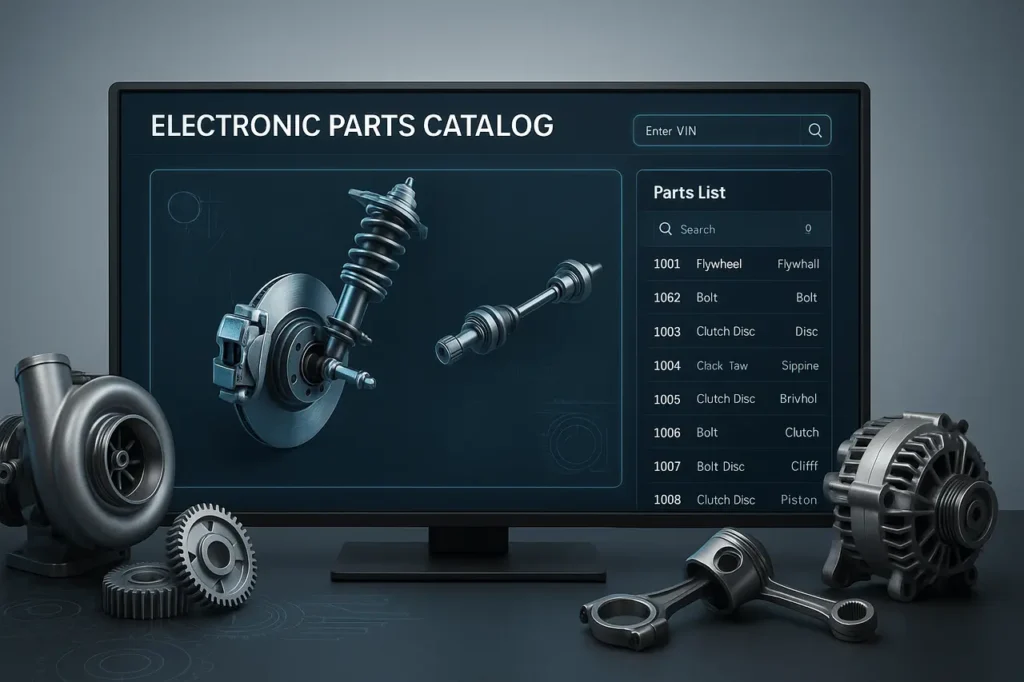
In fields like automotive, heavy machinery, and manufacturing, coordinating parts data effectively is vital in order to ensure proper operations, maintenance, and after-sales services. This is the reason why the EPC System (Electronic Parts Catalog) is required.
An EPC system is a centralization and digitization of details about parts, such as diagrams and part numbers, specifications, and compatibility details, making it more straightforward for technicians, dealers, and customers to find and buy the correct part.
Selecting the best EPC system can have a significant impact on your efficiency in business in terms of customer satisfaction, as well as the accuracy of your operations. This article outlines the most important features to consider when selecting the EPC solution to assist you in making the right choice for your company.
What is EPC system?
The EPC System (Electronic Parts Catalog) is an online platform that collects and provides complete information about spare parts, such as diagrams, part numbers, specifications, and compatibility information. It aids dealers, manufacturers, and service departments to quickly find, identify, and locate the appropriate components, increasing efficiency and accuracy in parts management.
Key Features to be looking at in the EPC System Step-by-Step guide
1. User-friendly and searchable interface
The first thing people observe in any EPC machine is its design and interface. An excellent EPC is one that is intuitive, user-friendly, and speedy.
Search for
- Intelligent search using VIN, part number, or model name
- Filter options and predictive text
- Visual diagrams and clickable parts
- A clean and fluid layout
Why it matters?
Technicians and part managers typically work under tight deadlines. A user-friendly, searchable interface speeds up lookups and increases the accuracy of finding components.
2. VIN, Model-Based search and Function
Modern EPC systems let users look up parts with the vehicle identification number (VIN) or model-specific filters.
Key Benefits:
- Ensures correct part identification
- Reduces human error when ordering
- Facilitates the process for multi-model dealerships.
Why it Matters?
If a technician inputs the vehicle’s VIN, the system displays parts that are compatible, which eliminates the need to cross-reference manually.
3. Parts Diagrams with illustrations in 2D/3D
Visual representation is among the most effective features in an EPC. Find systems that provide top-quality 2D and Interactive 3D drawings.
Features to be expected:
- Diagrams with explosions that show part assemblies
- Zoom-in and rotate capabilities
- Labeling and highlighting of the individual components
Why it matters?
Visual aids allow technicians to easily determine the exact part required and reduce the chance of errors during maintenance and ordering spare parts.
4. Integrating Real-Time Inventory and Prices
Your EPC system must be connected directly to the ERP and inventory management systems to give you the most current inventory availability and prices.
Must-have features:
- Updates on inventory in real-time
- Automated pricing adjustments based on the customer’s tier or region
- Integration with dealership or warehouse management software
Why it matters?
Dealers and customers are able to instantly look up the availability of parts and pricing, which improves efficiency and transparency of the ordering process for parts.
5. Multi-Language and Multi-Currency Support for Multi-Language and Multi-Currency
If your business is globally-based or in multiple countries, multi-language and multi-currency support is crucial.
Things to look out for:
- Dynamic translation of descriptions and names of parts
- Conversion of currency based on the user’s area
- Part catalogs based on region are different
Why it matters?
Global EPC System makes it simpler for technicians, distributors, and international customers to gain access to reliable information in their desired local language as well as their preferred currency.
6. Integration with Dealer and Service Networks
For distributors of large-scale and manufacturers for large-scale distributors, an EPC will integrate seamlessly into Dealer Management Systems (DMS) and service portals.
Search for
- Access to the dealer login with customized permissions
- Service history and order history
- Integration of CRM and after-sales systems.
Why it matters?
Dealers are able to access information about parts availability, part details, and other historical information directly to facilitate smoother communication and quicker order processing.
7. Mobile Accessibility
In the digital age, mobile access is no longer a luxury. Technicians in remote workshops or areas require access to EPC data via tablets or smartphones.
The most important features are:
- Responsive mobile interface
- Access to the internet offline for remote zones
- QR code scanning can retrieve information about parts
What it matters?
Mobile accessibility improves operational flexibility and helps ensure that technicians have the most critical information readily available at all times.
8. Advanced Search and Filtering Optional Options
EPC systems must go beyond the basic search engine. You should look for advanced filters that let users narrow results by model year, category, or engine type—part group.
Features to be expected:
- Search options include fuzzy and Boolean choices
- Filtering based on attributes (size, fitment, and type)
- Recent suggestions for search and history
Why it matters?
Advanced search tools can enhance the users’ experience, and speed up search for parts, particularly in catalogs with many thousands of SKUs.
9. Secure Access to Users and Role Management
Security and control are crucial in EPC systems that manage vast amounts of data from proprietary products.
Secure features that you should look out for:
- Access control based on role (e.g., admin, dealer, or customer)
- Secure login using Multi-factor authentication (MFA)
- Security of data encryption in catalogs for files, as well as transactions
Why it matters?
Secure access to sensitive data remains safe while granting the correct users the appropriate permissions to fulfill their roles.
10. Analytics and Reporting
A well-designed EPC system must include tools for analytics to monitor user behavior as well as popular parts and patterns of orders.
Examples of report templates that can be useful:
- The most sought-after or purchased parts
- Stock movement reports
- Performance analytics for regional or dealer-level performance
Why it matters?
These insights assist manufacturers in optimizing parts supply, predicting demand, and developing after-sales strategies.
11. Periodic Updates, Version Control, and Regular Maintenance
The machinery and automotive industries are constantly evolving. Your EPC system should be upgraded often to reflect the latest designs, as well as discontinued parts or numbers that have been superseded.
Find:
- Automatic updates to catalogs
- Tracking of version history
- Notification system for new releases
Why it matters?
Regular updates guarantee accuracy, avoid outdated data, and help maintain confidence in the customer.
12. Cloud-Based Architecture
The cloud-based EPC system provides flexibility, capacity, and access.
Advantages:
- There is no need for complicated local installations
- Updates in real time and backups
- Access to any device from anyplace
Whyit matters?
Cloud solutions streamline management and cut down on IT expenses while ensuring worldwide accessibility for your staff as well as your customers.
Final Thoughts
Selecting the best electronic Parts Catalog (EPC) system is vital to improve your service processes, enhancing the accuracy of your service, and ensuring seamless service for your dealers and customers.
When looking at the benefits of an EPC system, you should focus on user-friendliness and integration with security, data in real-time, and the ability to scale. A designed EPC system is not just a way to simplify the management of parts, but also enhances the reputation of your company’s brand for dependability and efficiency.
FAQs about EPC Systems
1. What exactly is an EPC system?
The electronic Parts Catalog (EPC) is an electronic platform that stores information, organizes, and displays information about spare components and parts, usually using diagrams, as well as compatible info.
2. Who is using EPC systems?
EPC systems are utilized by auto manufacturers, machinery suppliers, dealers, service centers, and maintenance groups to manage spare parts effectively.
3. What are the significant advantages that come with EPC? EPC system?
- More precise and faster Part identification is more precise and faster.
- Better inventory management
- A better customer experience
- Fewer errors in ordering and fewer returns
4. Is it possible for an EPC system to be integrated into my CRM or ERP?
Yes. The most effective EPC systems work seamlessly with CRM, ERP, and DMS platforms, which allows for smooth data flow between sales, inventory, and service systems.
5. Are cloud-based EPC systems superior to an on-premise EPC system?
Yes. Cloud-based EPC systems provide greater accessibility with real-time updates as well as lower maintenance costs than conventional on-premise systems.
6. How often do you recommend that the EPC be reviewed?
In the ideal scenario, manufacturers should update their EPC system when new models, components, or price changes happen, quarterly or with every new release of their product.