
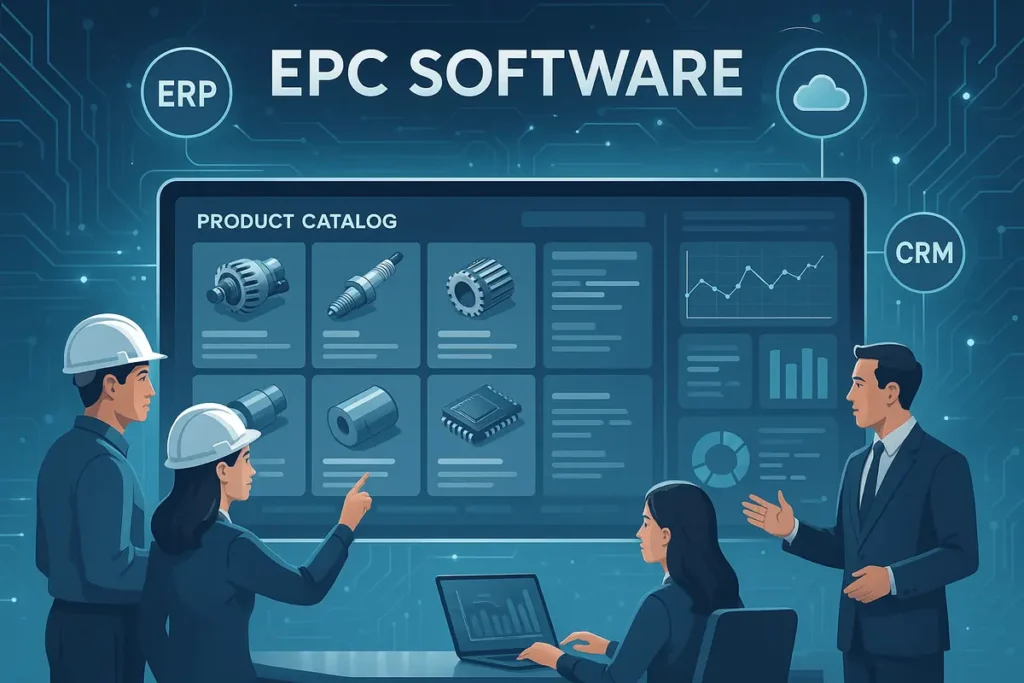
Electronic Parts Catalog is a simplified version of EPC Software. It has evolved into a critical tool in the digital age for businesses that handle massive amounts of data and volumes of components, parts, or services.
EPC software aids businesses in organizing and distributing information about their products to distributors, as well as service centres and their customers.
This guide will outline the basics of what EPC software actually is and how it functions, as well as the benefits it can provide and the reason its significance is more important than ever in 2025.
What Exactly is EPC Software?
EPC Software is Electronic Product Catalog Software at its heart. It is an electronic platform that stores, manages, and provides comprehensive information about the product. Think of it like an online store backend, with a blazing Excel spreadsheet. It contains everything from high-resolution images to precise specifications to prices, availability, and even information about suppliers.
EPC software, in contrast to traditional printed catalogs, which are a source of dust it is interactive and adaptable. Customers, sales teams, or procurement professionals can search and filter, and discover products in just a few seconds. This is particularly important in the fields of electronic retail, automobiles, and manufacturing industries, in which accuracy is needed.
EPC Software vs. Traditional Product Catalogs: Key Differences
| Aspect | Traditional Catalogs | EPC Software |
|---|---|---|
| Accessibility | Limited reach for PDFs that are static or physical | Cloud-based and mobile-friendly with 24/7 access |
| Updates | Reprinting of manuals and delays in making changes | Real-time edits; instant propagation |
| Searchability | Linear browsing; error-prone | AI-powered advanced filters |
| Cost | High printing/distribution fees | Subscription-based; scalable pricing |
| Integration | No or manual | Seamless integration with ERP, CRM and e-commerce |
By 2025, EPC will be more than a tool. It’ll give you a competitive advantage. Industry reports claim that businesses that use digital catalogs experience up to 30% faster discovery of products and a 15% reduction in cart abandonment.
Why EPC Software Matters in 2025
Customers expect seamless interactions in the digital world. A precise product database is vital, particularly in light of recent disruptions to supply chains. EPC software will ensure the sameness in all your channels, which include your site, listings on marketplaces, and mobile applications. It also provides AR/VR previews.
Recent studies on e-commerce have shown that the manual entry of data can result in errors between 20 and 30 percent for listings of products. EPC software automates the process of validation, which reduces the risks while increasing SEO through the use of extensive, structured data.
EPC tools are able to prevent costly mistakes in areas like electronics, where the components change constantly. B2B companies make use of customized catalogs to simplify quoting, and retailers can benefit from these tools. EPC software is a tool that tracks eco-friendly features that allow brands to reach out to green-conscious customers.
Key Features of EPC Software
Modern EPC platforms are loaded with features that are efficient. Here are a few things you can anticipate in 2025.
1. Centralized Product Data Management
- You can save unlimited SKUs and attributes like dimensions, materials and certifications, compatibility, and more.
- Support for various languages and currencies to reach an international public.
2. Advanced Searching and Filtering
- Search using keyword, attribute Keyword, attribute, as well as AI (e.g., “waterproof Bluetooth headphones under $50”).
- Upload a photo and search for items similar to it using visual search.
3. Rich Media Integration
- Include 360-degree views, videos as well, and interactive charts.
- AR previews allow customers to experience products in their actual surroundings.
4. Version control and real-time updates
- Notifications are sent out for price increases or stockouts.
- Revisions to be tracked for conformity (e.g., RoHS for electronic devices).
5. Ecommerce and Sales Tools
- Shopify, Amazon, or SAP ERP systems can be connected via API and include built-in shopping carts as well as quote generators.
- Dashboards that highlight what items are most popular, as well as conversion rates.
6. Workflow Automation and Collaboration
- Teams may be granted access to the system based on their role (e.g., engineers review descriptions, marketers edit them, and marketers are able to approve specifications).
- The workflows must be approved before publication to prevent errors.
7. Analytics
- Follow user engagement and popular search terms.
- AI-based predictive insight to predict the future.
Cloud deployment ensures scalability. The top platforms, like Salsify as well as Akeneo, are renowned for these attributes.
How Does EPC Software Work?
Anyone can start with EPC Software. Here’s a step-by-step explanation:
Step 1: Ingestion of Data
- Import data through CSV, XML, or APIs. Tools like ETL (Extract, Transform, and Load) and clean up and standardize data in a way that is automatic.
Step 2: Organization
- Sort items in a hierarchical fashion (e.g., Music > Electronics).
- Upload assets to your site. Upload images, create an SEO-optimized description, and include tags.
Step 3: Publishing
- Create dynamic catalogs that are in the form of PDFs or web portals.
- Distribute your updates to partners or other websites in real-time.
Step 4: User Interface
- Database users can access it via API, the web, or an app. Search queries are retrieved from the database to display a customized view.
- For instance, a user could filter by “USB-C chargers” to see available devices that are compatible and the stock levels.
Step 5: Maintenance
- Audits should be planned to verify the accuracy of data. AI detects duplicate entries and entries that are out of date.
- Integrate feedback loops: Sales data refines future listings.
Elasticsearch is a method used to carry out quick searches. Blockchain integrations will be made available in 2025 to safeguard information from suppliers.
Benefits of EPC Software for Businesses
Implementing EPC will yield a tangible ROI. Here are a few reasons EPC software is a game-changer:
- Efficiency Benefits: Data management can be reduced by 50-70%, and allows teams to concentrate on strategic tasks.
- Reduction of errors: Automated verification reduces the chance of mistakes and prevents returns (which result in the cost of $700 billion to retailers annually).
- Enhanced Customer Experience: Search speed and more engaging content improve customer satisfaction. Studies reveal that 88% of customers will not purchase from websites that provide poor information.
- Scalability: Manage expansion without corresponding increases in personnel; perfect for spikes in the season.
- Revenue Growth: Personalized catalogs boost the average value of orders by 20 percent through cross-selling.
- Sustainable and Compliance Follow carbon footprints as well as regulatory data to draw attention to investors who are focused on ESG.
Small-scale companies can benefit from lower barriers to entry (starting with as little as $50 per month), and enterprises can expect the return on investment within 6 to 12 months, thanks to savings in costs.
Choosing the Right EPC Software in 2025
With dozens of options, prioritize based on needs:
Top EPC Software Recommendations
| Software | Best For | Key Strength | Pricing (2025 Est.) |
|---|---|---|---|
| Salsify | Enterprise e-commerce | PIM integration, AI analytics | $10K+/year |
| Akeneo | Open-source flexibility | Custom attributes, multi-channel | Free core; $20K+ pro |
| Intelli Catalog | Parts-heavy industries | Visual exploded views | $5K-$50K/year |
| Documoto | Manufacturing/aftermarket | Engineering change mgmt. | Custom quote |
| OEC EPC | Automotive suppliers | Real-time procurement | Subscription-based |
Evaluate via demos: Import speed, mobile UX, and support. Data security should be SOC 2 compliant.
Implementation Tips for EPC Software Success
It’s not difficult to install EPC software. Follow these steps for those who are new to the field:
- Review your needs: Audit current data. How many SKUs do you have? Which channels? Participation of stakeholders early is essential.
- Begin with a smaller amount: Concentrate on a single area (e.g., the top 20 percent of revenues) to build momentum.
- Methodology for Data Migration: Use tools to transfer data in bulk; cleanse the data before uploading it.
- Learn your team: Offer hands-on sessions. Most platforms offer intuitive user interfaces. However, they are focused on workflows.
- Integration Gradually: Connect to one system (e.g. or the CMS you use) before you can extend.
- Monitor, and then Iterate: Create KPIs like frequency of updates and user feedback, and adjust them quarterly.
- Budget of Support: Include onboarding (often lasting between 4 and 8 weeks) and continuing training.
Common pitfall: Underestimating change management–communicate benefits to gain buy-in. Cloud-native technology is the best option for scalability in 2025.
Case Studies: EPC Software in Action
- Electronics retail store: A medium-sized gadget store has embraced Akeneo and reduced errors in listing by 40% and increased the sales online by 25 percent due to more mobile-friendly catalogs.
- Automobile parts maker: Documoto enabled dealers to access self-service portals, cutting time to respond by a few seconds from days, and growing orders by 35 percent.
These real-world achievements demonstrate the versatility of EPC.
Future Trends in EPC Software for 2025
EPC will be boosted by cutting-edge technology from 2025.
- AI and Machine Learning: Auto-generate descriptions, predict stock needs, and personalise recommendations-expect 60% adoption in predictive analytics.
- IoT and Digital Twins: Connect to sensors in order to monitor the status of products in real-time (e.g., monitoring warranty status via the connected device).
- Sustainability-focused: Carbon calculators integrated and tools to label the circular economy as eco-friendly.
- Voice AR/VR Shop through Alexa.
- Blockchain traceability: Supply chains that are secure from counterfeits, especially in the field of electronics.
EPC will be an essential element of immersive shopping as the metaverse continues to expand.
Final Thoughts
The year 2025 is when EPC Software will no longer be an optional feature. It’s now a necessity for any business that manages large amounts of data regarding items and products.
EPC systems increase efficiency and accuracy by centralizing and digitizing parts information.
EPC software is a bridge between the technical information and the user’s access to information, and will remain the central element of digital transformation as industries progress their transformation.
FAQs: Your EPC Software Questions Answered
What is the differentiator of EPC software as well as PIM software?
EPC (EPC) is focused on distribution and catalogs, while PIM, also known as Product Information Management, focuses more on the governance of data. PIM is typically integrated into EPC tools to make an integrated solution.
Is EPC software appropriate for small-sized companies?
Affordable options, such as free levels of Akeneo, make it cheap. Try out 100-500 items.
What do you think EPC will be in 2025?
Entry-level: $50-200/month; enterprise: $5K-50/year. The setup costs can range from 10 to 20 percent of the price for the year.
How long will EPC implementation be?
For beginners: 4-12 weeks, depending on data volume. In-progress rollouts will speed up the process.
Which industries are most benefited by EPC software?
Electronics, automotive, retail, and manufacturing–anywhere product variety and accuracy matter.
Is EPC software safe for sensitive product information?
The top providers offer privacy encryption and GDPR compliant, and access based on role. Verify the certifications.